



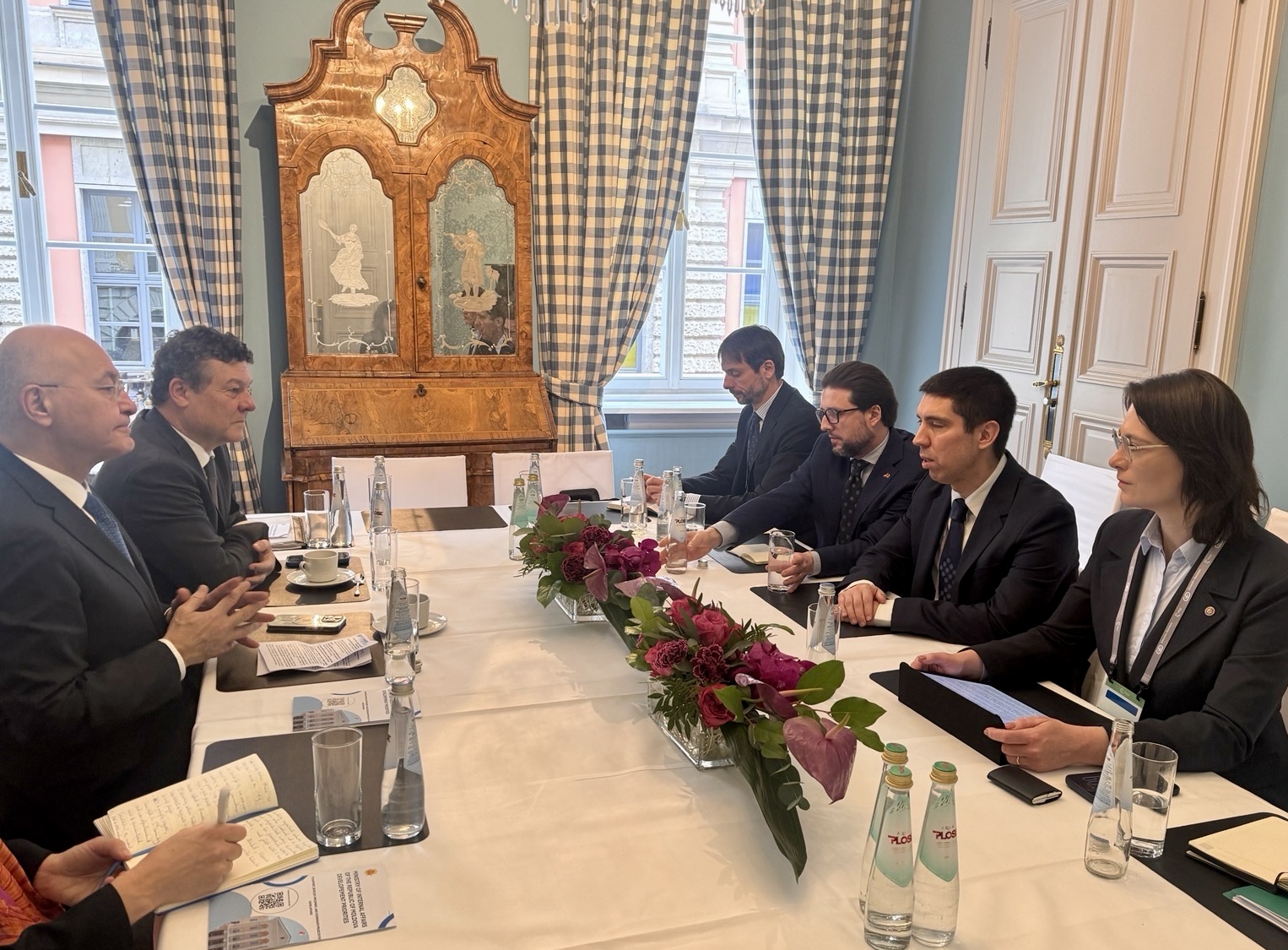
Moldova stands alongside countries committed to protecting citizens, safeguarding peace, and strengthening regional stability. At the Munich Security Conference, Moldova was represented by a delegation led by Maia Sandu, together with Deputy Prime Minister and Minister of Foreign Affairs Mihai Popsoi, Minister of Internal Affairs Daniella Misail-Nichitin, and Minister of Defense Anatolie Nosatii.
Citizen safety, modernization of equipment, and protection against hybrid threats were central to discussions with Bavarian Interior Minister Joachim Herrmann. The agenda also covered police cooperation, infrastructure development, and the promotion of inclusion and a gender-sensitive approach in the security sector.
Talks with State Secretary Daniela Ludwig of the German Federal Ministry of the Interior focused on the digitization of police services, the development of community policing, and professional exchanges for Moldovan officers, strengthening institutional capacity to respond effectively to evolving challenges.
Refugee management, border security, and countering disinformation were discussed with Åsmund Aukrust, highlighting the importance of long-term cooperation and sustainable support mechanisms.
Migration and asylum management, the extension of temporary protection for refugees from Ukraine, and institutional capacity-building through digital transformation were addressed in discussions with Susanne Raab, Director General of the International Centre for Migration Policy Development, with the aim of ensuring efficient and secure services for citizens and vulnerable groups.
The balance between security and fundamental rights, data protection, freedom of expression, and the ethical use of artificial intelligence was the focus of a meeting with Jan Philipp Albrecht, President of the Heinrich Böll Foundation. Discussions also explored democratic policing, green security, and societal resilience.
Transnational crime and secure public-private information exchange mechanisms were examined at the INTERPOL x APCO Round Table, where the Moldovan delegation contributed to discussions on protecting global trade from organized crime.
Hybrid warfare and emerging global risks were addressed during the sessions “Destructive Ambiguity” and “Emerging Threats Forum: Assessing the New Era of Global Risks,” where the interior minister presented Moldova’s experience in monitoring and countering persistent hybrid threats.
“The Munich Security Conference remains one of the leading international platforms for dialogue and coordination on regional and global security. It brings together leaders and experts to identify solutions to emerging challenges and hybrid threats, while offering new perspectives on how cooperation and partnership strengthen European and global resilience,” Daniella Misail-Nichitin stated.
Moldova’s participation in the forum reaffirms the country’s active role in international security dialogue, providing an opportunity to engage directly with global leaders on protecting citizens and ensuring regional stability, while advancing coordinated strategic policies that strengthen Moldova’s position as a responsible and predictable actor in the region.