



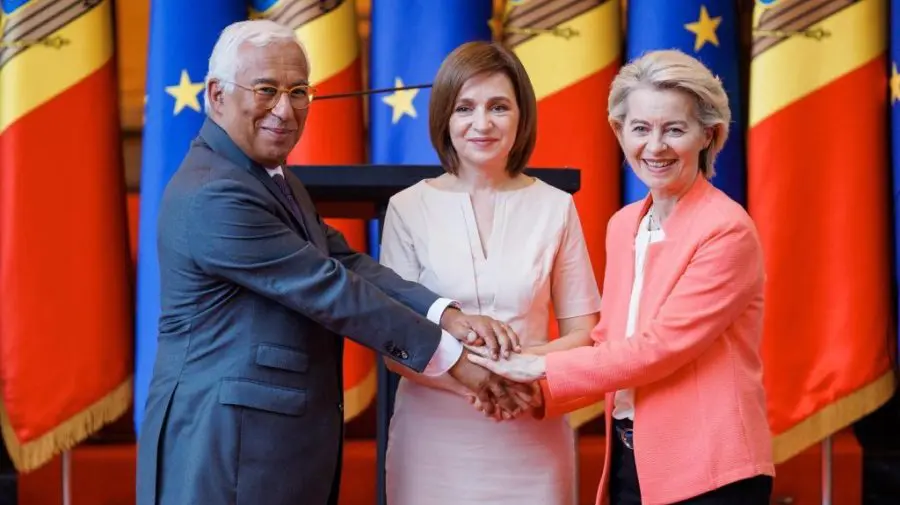
The President of the European Council António Costa and the President of the European Commission Ursula von der Leyen meet the President of the Republic of Moldova Maia Sandu in Brussels for the second EU–Moldova Summit, where leaders reaffirm Moldova’s strategic path toward European Union membership and deepen political and economic cooperation.
Leaders reinforce EU membership perspective
At the summit, EU and Moldovan leaders highlight Moldova’s future within the European Union and review progress on the country’s reform agenda. They assess developments in strengthening the rule of law, protecting fundamental rights, and combating organised crime, as Moldova continues to align its legislation with the EU acquis despite sustained external pressure.
The leaders also confirm the EU’s commitment to advancing Moldova’s accession process on a merit-based basis, following the formal opening of accession negotiations in 2024 and the recent launch of the first negotiation cluster covering fundamental reforms.
New agreements on research and innovation
The summit delivers a new non-binding research framework arrangement between the EU and Moldova to expand cooperation in innovation policy and smart specialisation strategies. Leaders also prepare to issue a joint declaration at the conclusion of the meeting, reaffirming shared priorities and long-term partnership goals.
Economic integration and financial support
The EU continues to support Moldova’s gradual integration into the internal market, aiming to strengthen economic growth and improve opportunities for businesses and citizens. Under the Moldova Growth Plan, the EU allocates up to €1.9 billion between 2025 and 2027 to support reforms, resilience, and convergence with EU standards.
EU leaders also underline the importance of the EU–Moldova Deep and Comprehensive Free Trade Area, which remains the backbone of bilateral trade. The EU remains Moldova’s largest trading partner, accounting for more than half of its external trade in goods.
Security, resilience, and regional context
The summit takes place against the backdrop of Russia’s ongoing war against Ukraine and increased hybrid threats targeting Moldova. EU leaders reaffirm their support for Moldova’s sovereignty, territorial integrity, and security, and they stress continued assistance in border management, humanitarian support, energy resilience, and countering disinformation.
The EU also strengthens cooperation with Moldova in security and defence through the EU–Moldova Security and Defence Partnership and continues supporting the modernisation of Moldova’s armed forces via the European Peace Facility.
Energy, digital, and transport integration
Leaders review progress in energy security, including diversification of supply and improved efficiency. They also highlight Moldova’s inclusion in the EU “roam like at home” regime from 2026, which allows citizens to use mobile services across borders without additional charges.
Further discussions focus on digital alignment with EU regulations, cybersecurity resilience, and efforts to counter information manipulation. Transport connectivity and people-to-people exchanges remain key priorities, alongside Moldova’s participation in EU programmes in education, youth, environment, agriculture, and research.
Outlook
The EU reiterates its commitment to supporting Moldova’s reform process and its long-term European integration. Leaders conclude that Moldova’s sustained progress and reform efforts will determine the pace of accession, while the EU pledges to continue providing political, financial, and technical support throughout the process.