



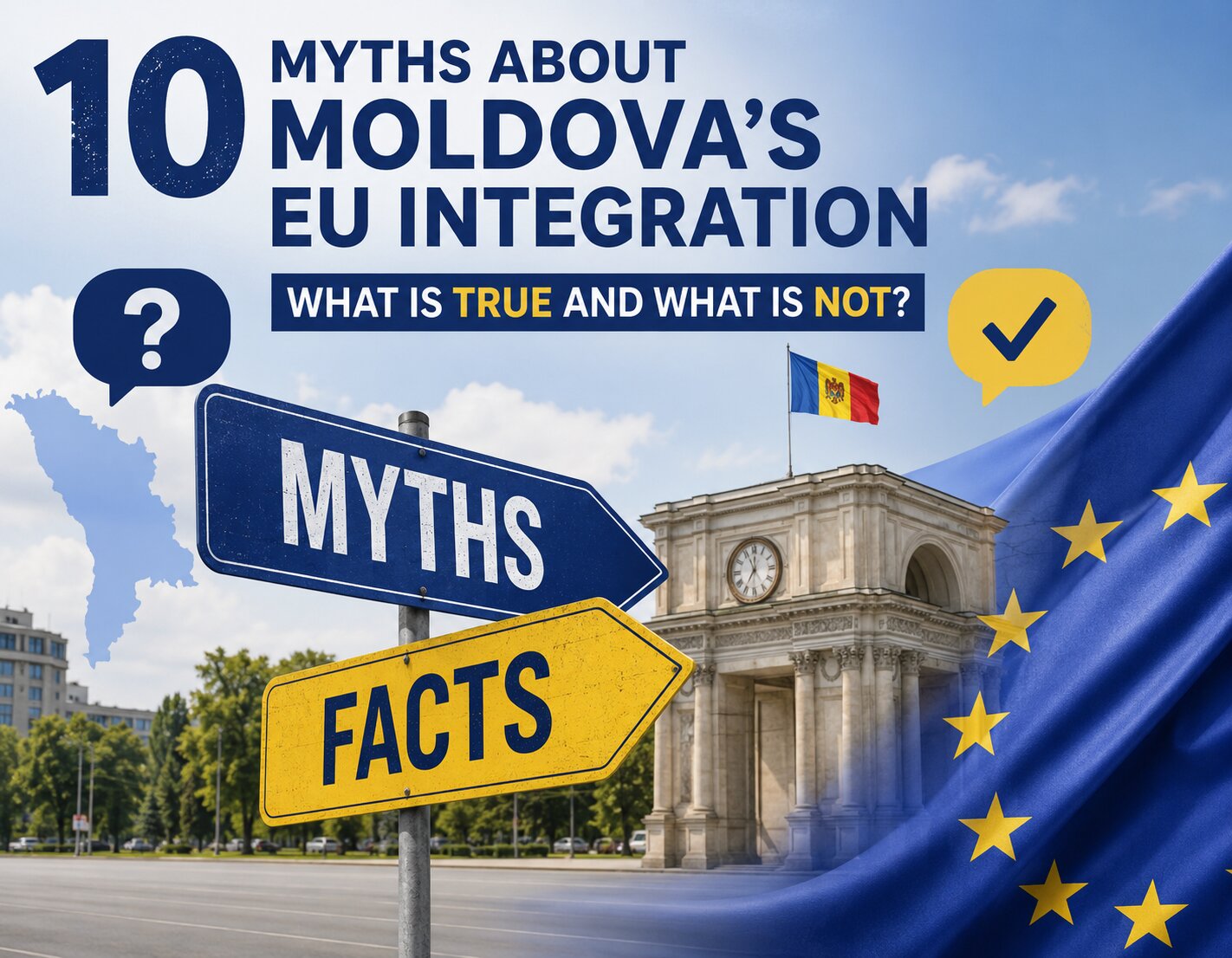
From sovereignty and national identity to prices and economic opportunities, MoldovaLive looks at the most common misconceptions surrounding Moldova’s path toward the European Union.
Moldova’s path toward the European Union has become one of the defining issues shaping the country’s future. Since applying for EU membership in 2022 and receiving candidate status, Moldova has been undergoing a major transformation aimed at aligning its institutions, economy and legislation with European standards.
At the same time, EU integration has sparked many debates — both inside Moldova and abroad. Questions about sovereignty, traditions, economic changes and relations with other countries remain among the most discussed topics.
MoldovaLive examines 10 common myths about European integration and explains what the facts say.
Myth 1: Joining the EU means Moldova will lose its independence
Fact: EU membership does not mean giving up statehood.
European Union members remain independent countries with their own governments, national symbols, languages and cultural identities.
EU membership means cooperation in areas where countries decide to act together — such as trade, environmental protection, consumer rights and economic development.
Many smaller countries, including Estonia, Latvia, Slovenia and Luxembourg, are EU members while preserving their own identities and national interests.
For Moldova, European integration would mean becoming part of a larger political and economic community while maintaining its sovereignty.
Myth 2: Moldova will lose its national identity inside the EU
Fact: The EU is built on diversity, not uniformity.
The European Union brings together countries with different histories, languages and traditions.
Membership does not require countries to abandon their cultural heritage. Instead, many EU states use European programmes to promote their traditions, local products and cultural events internationally.
For Moldova, EU integration can create new opportunities to showcase its traditions — from wine culture and gastronomy to crafts and national celebrations.
Myth 3: EU integration means Moldova will have to abandon its traditions
Fact: European countries continue to preserve their customs.
Across the EU, traditional festivals, rural lifestyles and local cultures remain an important part of national identity.
From Italian regional cuisine to Baltic folk traditions, European integration has not eliminated cultural differences.
Moldova’s traditions — including Mărțișor, traditional crafts and winemaking — can become part of a broader European cultural dialogue.
Myth 4: EU integration will automatically make prices higher
Fact: Economic changes can bring challenges, but also opportunities.
Countries undergoing major economic transformations may experience changes in prices, markets and business conditions.
However, EU integration can also bring:
- increased investment;
- access to a larger market;
- infrastructure development;
- support programmes;
- stronger consumer protections.
The impact depends on the country’s reforms and ability to adapt.
Myth 5: Only big companies benefit from EU integration
Fact: Small businesses and local producers can also gain new opportunities.
The EU single market gives companies access to hundreds of millions of consumers.
For Moldovan businesses, European integration can create opportunities in sectors such as:
- agriculture;
- wine production;
- tourism;
- IT;
- manufacturing.
At the same time, companies must adapt to European quality standards and competition.
Myth 6: Moldova will stop trading with countries outside the EU
Fact: EU countries trade with partners around the world.
Joining the EU does not mean ending international economic relations.
EU members maintain partnerships with countries across different regions and continue developing global trade.
For Moldova, European integration means deeper access to the EU market while remaining connected to international partners.
Myth 7: Small countries have no influence inside the EU
Fact: Smaller EU members still participate in decision-making.
The EU includes countries of different sizes, but every member state has a role in European institutions.
Countries such as Malta, Estonia and Slovenia demonstrate that smaller states can influence discussions and defend their interests within the EU framework.
Myth 8: EU integration only affects politicians
Fact: European integration affects everyday life.
The process is not only about government negotiations. It can influence areas directly connected to citizens, including:
- education opportunities;
- mobility;
- consumer rights;
- digital services;
- infrastructure;
- economic opportunities.
For many people, the success of integration will be measured by practical improvements in daily life.
Myth 9: Moldova is too small and too poor to join the EU
Fact: Economic size is not the only factor determining EU membership.
The EU includes countries of different sizes and economic levels.
The accession process focuses on reforms, strong institutions, rule of law and the ability to implement European standards.
Moldova’s progress will depend on continued reforms and modernization.
Myth 10: Moldova has to choose between Europe and its neighbours
Fact: European integration does not erase Moldova’s regional connections.
Moldova will continue to have geographic, cultural and economic ties with neighbouring countries.
Many EU members maintain strong relationships with countries outside the bloc.
For Moldova, the European path represents a strategic choice for development while remaining part of a wider regional environment.
Why understanding the facts matters
Moldova’s European integration is not only about joining an international organisation. It is about transforming institutions, strengthening the economy and creating new opportunities for citizens.
As Moldova moves closer to the EU, understanding the facts behind the debate becomes increasingly important — both for people inside the country and for international audiences following Moldova’s transformation.