




Moldova’s new public sector salary law will enter into force on January 1, 2027, meaning the planned salary increases cannot be implemented from September 1, 2026, Prime Minister Vasile Tofan announced on Wednesday.
The new legislation was expected to increase salaries for around 170,000 public sector employees starting this autumn. However, Tofan said the state budget currently lacks the resources needed to implement the reform.
“We need to introduce a new fiscal policy to increase revenues so that we can honor this law. On behalf of the Government, I apologize that we were unable to increase salaries this autumn. I want to guarantee that this law will enter into force. These increases will be implemented from January 1, 2027; it is not possible earlier,” Tofan said.
According to the prime minister, more than 5 billion lei would be needed to implement the salary increases, but these funds are not currently available in the budget.
From January 1, 2027, the public sector wage bill is expected to exceed 38 billion lei, more than 5 billion lei above the 2026 level.
Under the reform, teachers’ salaries are expected to increase by approximately 10–15%, depending on their category. Salaries in public order institutions are projected to rise by 15%, while employees in healthcare and defense would receive increases of 17%. Salaries in the judiciary are expected to increase by 9%.

How the new salary system will change
The reform will also change the way public sector salaries are structured. The basic salary will incorporate most allowances and account for at least 70% of total income, while the variable component will be capped at 30%.
The authorities also aim to narrow the gap between the lowest and highest salaries. The current ratio within the salary scale can reach 1:15, while the reform would reduce it to 1:10.5, meaning lower salaries are expected to grow faster than higher ones.
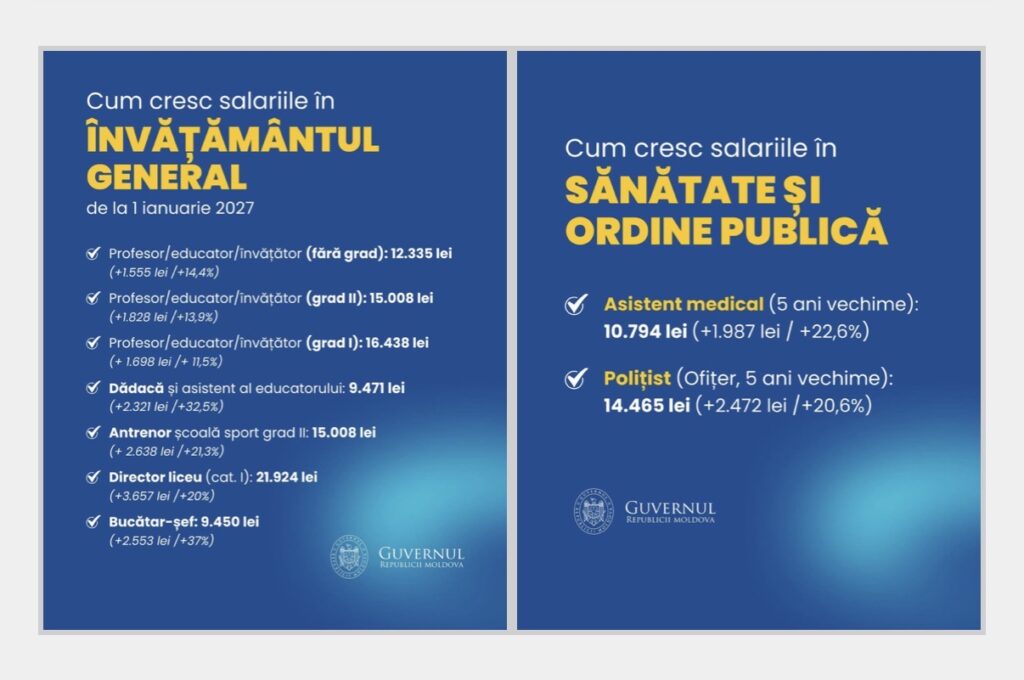
Performance bonuses will also be changed. They will be capped at 4% of the basic salary and will no longer be granted automatically, but instead used as an incentive for employees.
The fund for one-off bonuses will be reduced from 5% to a maximum of 2% of the annual basic salary fund. According to the authorities, this will allow more resources to be directed toward basic salaries and make employees’ incomes more stable and predictable.
The number of reference values used to calculate salaries will also gradually decrease — from 10 in 2026 to six in 2027 and eventually to four by 2032.
The announcement came amid Wednesday’s protest by education sector employees. Hundreds of teachers, education workers and trade union representatives gathered outside the Government building to demand that the promised salary increases be implemented from September 1.
The new Salary Law, originally expected to take effect this autumn, was presented in June by then-Finance Minister Andrian Gavriliță and Labour and Social Protection Minister Natalia Plugaru. The authorities said the reform was intended to create a fairer salary system, increase the share of basic salaries in total public sector income and gradually reduce the number of reference values.