



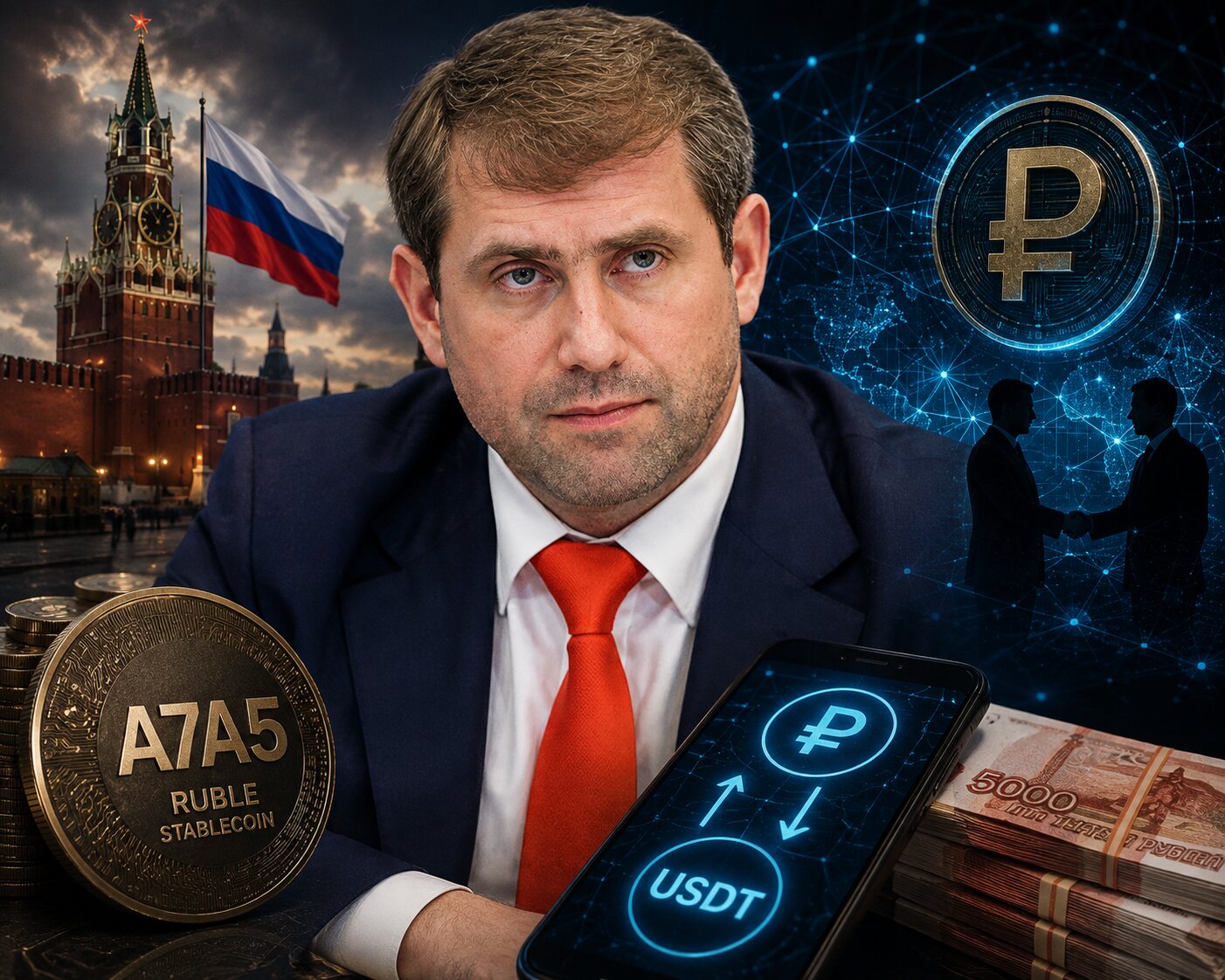
Moldovan fugitive businessman and politician Ilan Shor has emerged as a key figure in Russia’s efforts to circumvent Western sanctions, according to an investigation published by The Economist.
Once at the centre of Moldova’s biggest banking scandal, Shor has built a new role for himself in Russia, where he is now involved in a cryptocurrency-based financial network designed to help Russian businesses move money internationally despite restrictions imposed by the United States and its allies.
Digi24 describes Shor as the “crypto king of the Kremlin”, highlighting his involvement in A7, a Russian financial company behind A7A5, a ruble-backed stablecoin that has rapidly become one of the most important digital payment instruments connected to Russia.
The story represents a remarkable transformation for a man who was once primarily known in Moldova as the central figure in the country’s billion-dollar banking fraud.
Today, Shor operates from Russia and has become closely connected to a financial infrastructure that Moscow is developing as an alternative to Western-controlled banking channels.
From Moldova’s billion-dollar banking scandal to Moscow’s crypto world
Shor’s background is essential to understanding his current role.
He became one of Moldova’s most controversial businessmen after being linked to the disappearance of approximately $1 billion from three Moldovan banks in 2014.
The scandal, which became known as Moldova’s “bank theft,” triggered a political and financial crisis in the country. Shor was subsequently convicted by a Moldovan court and sentenced to 15 years in prison.
He has denied wrongdoing and has repeatedly portrayed the Moldovan legal proceedings against him as politically motivated.
After leaving Moldova, Shor eventually established himself in Russia.
There, his career took an unexpected turn.
Instead of remaining primarily a political figure, he became involved in the creation of an alternative financial infrastructure based on cryptocurrency.
This infrastructure has become increasingly important as Russia faces unprecedented restrictions on its access to Western financial markets.
A7A5: Russia’s ruble-backed cryptocurrency
At the centre of the system is A7A5, a stablecoin whose value is linked to the Russian ruble.
The cryptocurrency was launched in early 2025 by A7, a financial company in which Shor holds a majority stake.
According to information cited by Digi24, Shor owns 51% of A7, while the remaining 49% belongs to Promsvyazbank, a Russian state-controlled bank that has been heavily sanctioned by Western governments.
That ownership structure is particularly significant.
Promsvyazbank is closely connected to Russia’s defence sector and has become one of the country’s key financial institutions operating under sanctions.
The partnership therefore brings together two very different worlds: a private businessman with extensive experience in unconventional financial networks and a Russian state bank deeply integrated into the country’s wartime economy.
The result is A7A5.
Unlike Bitcoin, whose price fluctuates according to market demand, A7A5 is designed to maintain a relatively stable value by being linked to the ruble.
This makes it more useful for payments than for conventional cryptocurrency speculation.
How the system works
The importance of A7A5 lies not simply in the token itself but in what it allows users to do.
A Russian company can convert rubles into A7A5 and use the cryptocurrency to transfer value outside Russia.
The funds can subsequently be converted into other digital assets, including dollar-backed stablecoins such as USDT.
This creates a bridge between Russia’s financial system and the international cryptocurrency market.
The key advantage is speed.
Money can move through the cryptocurrency ecosystem without spending significant amounts of time in a traditional Western-linked banking system.
That is particularly important for Russian companies operating under sanctions.
Western financial institutions can freeze or block conventional bank transfers involving sanctioned Russian entities. Cryptocurrency transactions, however, can move through blockchain networks without requiring the same traditional banking intermediaries.
The A7A5 system attempts to exploit precisely that difference.
Why USDT is important
The system becomes even more interesting when A7A5 is exchanged for USDT, the world’s largest dollar-backed stablecoin.
According to the reporting described by Digi24, A7A5 can serve as a temporary bridge between Russian rubles and the global crypto market.
A Russian user can hold value in A7A5, move it through the network and then convert it into USDT.
The crucial element is that the exposure to the international cryptocurrency system can be relatively short.
That makes it more difficult for sanctions authorities to intervene at every stage of the transaction.
However, this also represents one of the system’s main vulnerabilities.
USDT operates on a global cryptocurrency infrastructure and its issuer, Tether, has cooperated with law-enforcement authorities by freezing assets connected to sanctioned entities.
Consequently, the longer funds remain in the USDT ecosystem, the greater the potential exposure to Western enforcement mechanisms.
A7A5 attempts to solve that problem by functioning as a rapid intermediary.
More than $100 billion in transactions
The scale of A7A5’s growth has attracted considerable attention.
According to blockchain analytics company Elliptic, more than $100 billion passed through A7A5 in less than a year.
The size of the transactions is particularly striking because A7A5 is not comparable to major global cryptocurrencies in terms of market capitalization.
Its importance comes from the volume of money moving through the network.
Blockchain investigators also found that A7A5’s transaction patterns differed significantly from those of ordinary cryptocurrency traders.
Large transactions were concentrated during Russian working hours and on weekdays.
That pattern suggests that a significant share of the activity was connected to businesses conducting commercial payments rather than individual investors trading cryptocurrency for profit.
In other words, A7A5 appears to have been developed primarily as a financial tool rather than a speculative cryptocurrency.
A network built for Russia under sanctions
The emergence of A7A5 cannot be separated from Russia’s changing financial environment.
Since Moscow’s invasion of Ukraine in February 2022, the United States, European Union, United Kingdom and other Western countries have imposed extensive sanctions on Russian banks, companies and individuals.
Russia was cut off from significant parts of the Western financial system, while many of its largest banks and corporations lost access to international financial infrastructure.
Moscow responded by attempting to build alternative payment mechanisms.
China became increasingly important.
Russian companies began settling more transactions in yuan, while Russia expanded financial relationships with countries across Asia, the Middle East, Africa and Latin America.
Cryptocurrency added another layer to this system.
A7A5 effectively combines the Russian ruble with the global digital-asset ecosystem.
For Moscow, that creates the possibility of moving money internationally without relying entirely on traditional Western banking institutions.
Payments linked to Russian trade
Digi24’s account highlights reports that the A7A5 network has been used in transactions connected with Russian international trade.
Among the reported examples are payments involving Russian gas sold to Turkey and purchases of components from China by Russian drone manufacturers.
Such transactions illustrate why the system is strategically important.
If cryptocurrency can be used to settle payments for energy, industrial goods and components, it becomes more than a tool for wealthy individuals seeking to move money.
It becomes part of the infrastructure supporting Russia’s economy.
The distinction is critical.
Russia does not necessarily need cryptocurrency to replace the entire banking system.
It only needs alternative channels that allow important transactions to continue when conventional channels are blocked.
A7 is attempting to provide exactly such a channel.
The Kyrgyzstan connection
Another important element of the story is Kyrgyzstan.
A significant part of the A7A5 infrastructure has been connected to companies and operations in Kyrgyzstan, providing the network with a presence outside Russia.
This reflects a broader feature of sanctions-evasion networks.
The money does not necessarily move directly from Russia to its final destination.
Instead, transactions can pass through companies and financial institutions in third countries.
That makes the system considerably more difficult to monitor.
For Shor, Kyrgyzstan has also become an important part of his broader international activities.
His network has expanded beyond financial operations, demonstrating how commercial, political and geopolitical interests can overlap.
A7’s ambitions go beyond cryptocurrency
According to the reporting cited by Digi24, A7’s ambitions are much larger than simply operating a cryptocurrency.
The company is seeking to build a parallel payment infrastructure capable of connecting Russia with countries outside the Western financial system.
Its expansion has reportedly reached Africa, with offices established in countries including Nigeria and Zimbabwe.
The company is also looking toward other emerging markets.
This could eventually allow A7 to function as a broader international payments network for businesses operating outside the traditional Western financial system.
Such ambitions are significant because Russia is not the only country facing Western sanctions.
If a financial network created for Russia proves successful, the same infrastructure could potentially be attractive to companies and individuals in other sanctioned jurisdictions.
The Kremlin’s support
Shor’s position is particularly unusual because A7 has received visible support from the Russian state.
Russian President Vladimir Putin participated remotely in the opening of an A7 branch in Vladivostok.
That appearance sent a powerful political signal.
It suggested that A7 was not merely a private cryptocurrency project operating on the fringes of the Russian financial system.
Instead, it had become part of Moscow’s broader strategy to develop alternative financial channels.
The involvement of Promsvyazbank reinforces that impression.
The bank is not an obscure private institution. It is a major Russian state-linked financial organisation that has been integrated into the country’s defence economy.
A7 therefore sits at the intersection of private business, cryptocurrency and Russian state interests.
Western sanctions strike back
The rise of A7A5 has also triggered a response from Western governments.
The United States, European Union and United Kingdom have imposed sanctions on companies and individuals associated with the network.
The objective is to prevent A7 from becoming a fully functioning alternative to Western financial infrastructure.
Blockchain investigators say the pressure has had a significant effect.
After sanctions targeted parts of the A7 ecosystem, transaction volumes associated with A7A5 reportedly dropped by approximately 96%.
The fall demonstrates that cryptocurrency does not automatically make a financial network immune to sanctions.
Even if transactions occur on a blockchain, users still require exchanges, liquidity providers, banks and other services to convert digital assets into usable currencies and goods.
Those points of connection can be targeted.
But the system has already demonstrated its potential
Despite the decline in activity, A7A5’s rapid expansion remains significant.
The network demonstrated that Russia could construct a new financial channel relatively quickly by combining cryptocurrency with state-backed banking institutions and companies operating in third countries.
The lesson for Western governments is important.
Sanctions can make traditional financial channels unavailable, but they can also create incentives for sanctioned states to build alternative infrastructure.
Once such infrastructure exists, shutting down one company or exchange may not be enough.
New entities can emerge elsewhere.
New tokens can be created.
And transactions can be redirected through different jurisdictions.
This makes the battle between sanctions authorities and sanctions-evasion networks increasingly similar to an arms race.
Why Shor is so important
This is where Ilan Shor’s personal story becomes central.
A man once known primarily in Moldova for his involvement in one of Europe’s largest banking scandals has found a new role in Russia’s financial transformation.
His experience in unconventional financial structures appears to have become an asset.
For the Kremlin, Shor is useful precisely because he operates outside the traditional Russian establishment.
He has international connections, experience with complex financial structures and a history of operating in environments where conventional institutions are under pressure.
The result is a remarkable reversal of fortunes.
In Moldova, Shor became synonymous with the country’s banking scandal.
In Russia, he has become a businessman involved in one of the country’s most ambitious attempts to build a parallel international payments system.
A new financial battlefield
The story of A7A5 is ultimately larger than Ilan Shor.
It illustrates how the global financial system is changing under geopolitical pressure.
For decades, access to the dollar, international banks and payment systems such as SWIFT gave Western governments enormous leverage.
Financial sanctions became one of the most powerful tools available to punish states, companies and individuals.
Russia’s response shows that this leverage is not absolute.
Moscow is attempting to create alternative systems using national currencies, cryptocurrency, Chinese financial infrastructure and companies based in third countries.
A7A5 is one component of that broader strategy.
Its future remains uncertain.
Western sanctions have already demonstrated that the network can be disrupted, and its transaction volumes have fallen sharply following international action.
But the basic idea behind it is unlikely to disappear.
As long as Russia remains cut off from parts of the Western financial system, Moscow will have strong incentives to develop alternative mechanisms.
And Ilan Shor — once a central figure in Moldova’s billion-dollar banking scandal — now finds himself at the centre of that effort.
For a businessman who fled Moldova after being convicted over one of Europe’s most notorious banking frauds, becoming a key player in Russia’s sanctions-era financial system is an extraordinary transformation.
It is also precisely why The Economist has described him as the “Kremlin’s crypto king.”