



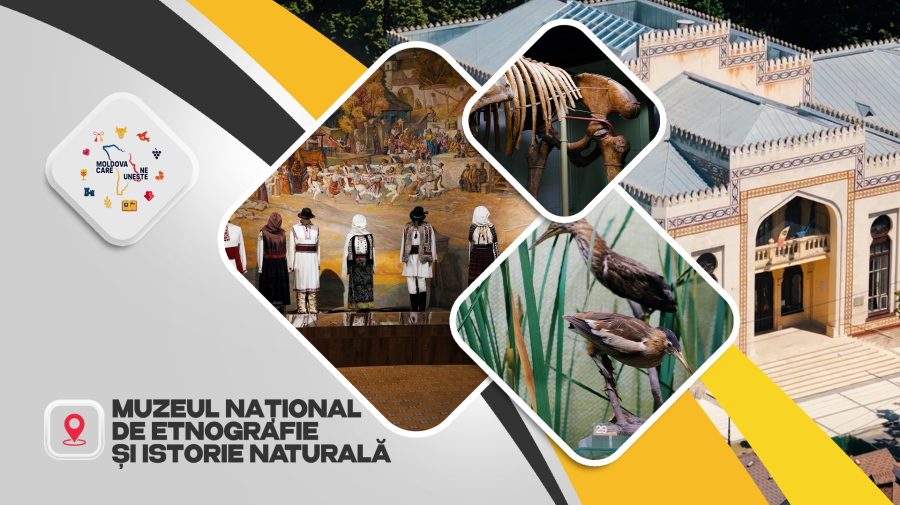
In the heart of Chisinau stands one of the Republic of Moldova’s oldest and most valuable cultural institutions: the National Museum of Ethnography and Natural History. Founded in 1889, it is the oldest museum in the country and one of its most important centers for research and preservation of natural and ethnographic heritage.
The museum’s building, designed by architect Vladimir Tsiganco, is one of Chisinau’s most distinctive architectural landmarks. Its design was inspired by the Moorish style associated with the Islamic countries of North Africa. The symmetrical facade features polychrome maiolica panels, horseshoe-shaped windows and decorative ornaments. Inside, visitors can see colorful stained-glass windows and epigraphic elements inspired by Oriental art.
Over the decades, the museum has significantly expanded its scope. What began as an agricultural museum evolved into a comprehensive institution dedicated to nature, traditional culture and the development of society in the territory of Bessarabia and, later, the Republic of Moldova.
The museum’s permanent exhibition, titled “Nature. Man. Culture,” occupies more than 2,000 square meters. It explores the evolution of the organic world, the relationship between humans and nature, the use of natural resources and the particular characteristics of Moldova’s environment.
One of the museum’s most impressive exhibits is the skeleton of a Deinotherium gigantissimum, discovered in 1961 near the village of Pripiceni-Rezeși. Measuring approximately six meters in length and four meters in height, it is considered one of the largest skeletons of this species ever discovered.
The museum’s collections contain more than 200,000 items, including ethnographic objects, traditional costumes, Bessarabian carpets, zoological and botanical collections, as well as archaeological treasures discovered in different parts of the country.
Among the most notable archaeological finds are the treasures from Carbuna, Valea-Rusului and Largutsa. They include coins dating back to the 4th century BC bearing the effigy of Philip II, King of Macedon.
The museum grounds are also home to a Botanical Garden, established in 1906. It contains many of the plant, tree and shrub species commonly found in Moldova. The garden also features a vivarium where visitors can see rare birds, reptiles and fish.
For more than a century, the National Museum of Ethnography and Natural History has remained one of Moldova’s key scientific and cultural institutions. Its collections tell the story of the country’s natural world and traditions, while each exhibition hall offers visitors a journey through the history and identity of the region.
The museum is open to visitors from Tuesday to Wednesday from 10:00 to 18:00 and from Thursday to Sunday from 10:00 to 17:00.