



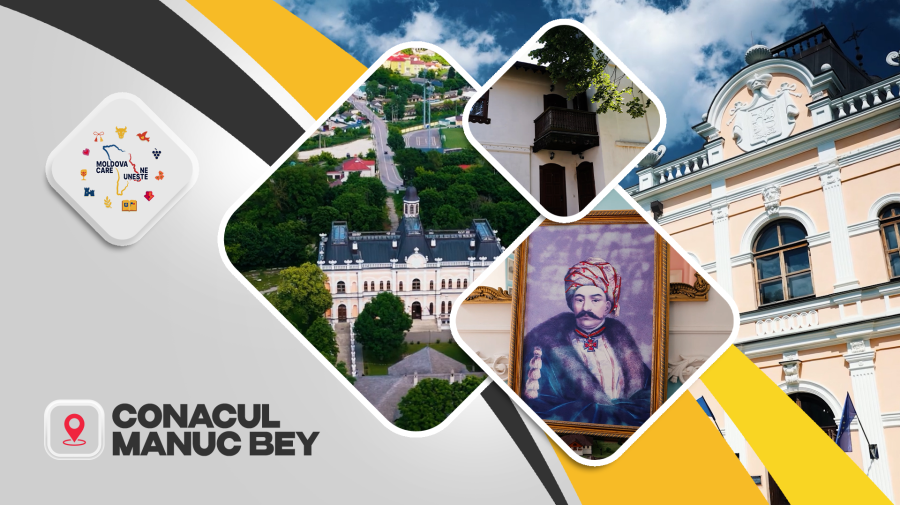
In southwestern Moldova, in Hincesti, stands one of the country’s most impressive historical landmarks – the Manuc Bey Mansion. The historic and architectural complex, restored in recent years and reopened to visitors, preserves the story of an era when noble families built grand residences and architecture became a symbol of prestige and power.
The story of the estate is connected to Manuc-Emmanuel Mirzoian, known in history as Manuc Bey – an Armenian-born merchant and diplomat who was born in 1769. After the Russo-Turkish War of 1806-1812, he settled in Chisinau for a period and, in 1815, purchased the Hincesti estate for 300,000 gold lei. Although the mansion bears his name, it was not built by Manuc Bey himself, but by his descendants. Construction was started by his son, Murat, and completed by his grandson, Grigore, between 1858 and 1861.
A French-Style Castle in the Heart of Moldova
The family built a true French-style castle surrounded by an extensive park, watchtowers and a winter garden.
The complex includes several buildings: the Manuc Palace, the Bailiff’s House, the Countess’s Building, the Hunting Castle and the Watchtower.
The palace was designed by renowned architect Alexandru Bernardazzi and is notable for its elegant architecture inspired by European classicism. According to historical accounts, the interiors were decorated in four different styles – Armenian, Turkish, Moldovan and European – while the ceilings of some rooms are said to have been painted by renowned artist Ivan Aivazovsky.
From Soviet-Era Institution to Restored Landmark
Over the decades, the mansion underwent numerous transformations. After World War II, the complex was taken over by Soviet authorities and initially turned into a mechanization school, later becoming a construction college.
The 1986 earthquake severely damaged the buildings, and the estate gradually fell into disrepair.
In 1993, the complex was granted the status of an architectural monument. Major restoration work, however, began only in 2014, with financial support from the European Union.
The restoration lasted nearly two years and brought the palace back to much of its former appearance. Bedrooms, reception rooms, dining rooms and offices were carefully restored, while furniture was recreated based on historical models or brought from other residences belonging to the family.
More than 60 specialists from Moldova and Romania worked on the restoration in an effort to recreate the authentic atmosphere of the 19th century.
Underground Tunnels and the Hunting Castle
One of the features that continues to fascinate visitors is the network of underground tunnels. Some of the galleries connected buildings within the complex and served as escape routes in case of danger.
One tunnel, approximately 70 meters long, has been restored and is open to visitors.
Another important building is the Hunting Castle, constructed in 1881, also based on a design by Alexandru Bernardazzi. It now houses the Museum of the Native Land, where visitors can discover ethnographic objects, old photographs, historical documents and exhibits illustrating the life and traditions of the region’s inhabitants.
Today, the restored and reopened complex attracts thousands of visitors every year, offering a fascinating journey into Moldova’s history and architecture.
The palace, surrounding buildings, park and underground galleries transform Manuc Bey Mansion into a remarkable historical complex where the past comes back to life.