



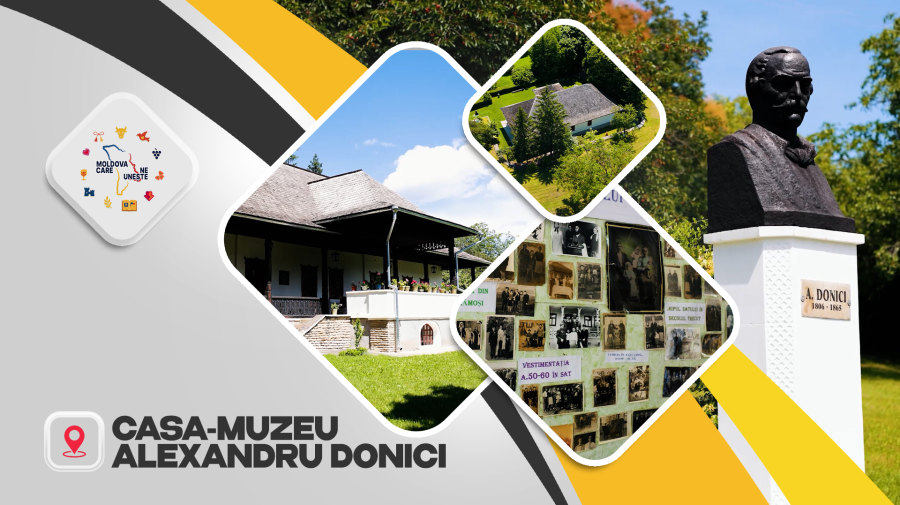
About 37 kilometers from Chisinau, in the village of Donici, Orhei District, lies one of Moldova’s most important memorial museums — the Alexandru Donici House-Museum. This is where the Bessarabian poet and fabulist Alecu Donici was born, one of the best-known authors of the 19th century.
The Donici family manor was built in 1765 and belonged to an old boyar family from the area. Alexandru Donici spent his childhood in this house and later became known for his fables, many of which became classics of Romanian literature. Over the years, the building served several purposes. During the Soviet period, it housed a school, and only in 1977 was the house converted into a memorial museum.
The building stands in the middle of a small park and is part of a larger museum complex. A bust of Alexandru Donici, installed in 1969, stands in the courtyard. Nearby are the Donici family church, the family crypt where several members of the Donici family are buried, and the Stânca spring, arranged in the early 19th century by the fabulist’s parents.
The interior of the house preserves the atmosphere of the era in which the writer lived. The manor covers approximately 200 square meters and has eight rooms, four of which have been arranged as exhibition halls. The “Great Room” is decorated with objects characteristic of the 19th century, including Bessarabian carpets, period furniture, silver candlesticks, a sideboard and an extendable table with chairs. The ceiling features floral motifs, while a small piano evokes the atmosphere of the boyar houses of the past.
Another room recreates the fabulist’s study. It contains a writing desk, a library with 19th-century volumes, a period clock and other objects recreating the environment in which the writer might have worked.
The museum also displays documents, old publications, photographs and household objects illustrating the life of the Donici family. Of all the fabulist’s personal belongings, only one has survived to this day — a weapon dating from the first half of the 19th century.
The museum complex also includes the Church of the Dormition of the Mother of God, founded by the Donici family. The first wooden church was built in 1820 by the writer’s parents, Dimitrie and Elena Donici. In 1875–1876, it was replaced with a stone church built with the support of the fabulist’s brother, Andrei Donici, and his son, Nicolae.
During the Soviet period, the church was closed and converted into a grain warehouse. It was reopened and restored only after 1992 and is now part of the museum complex dedicated to the Donici family.
Today, the Alexandru Donici House-Museum offers visitors an opportunity to discover not only the life of the Bessarabian fabulist, but also the story of a boyar family and an era when literature, culture and rural life were closely intertwined.