


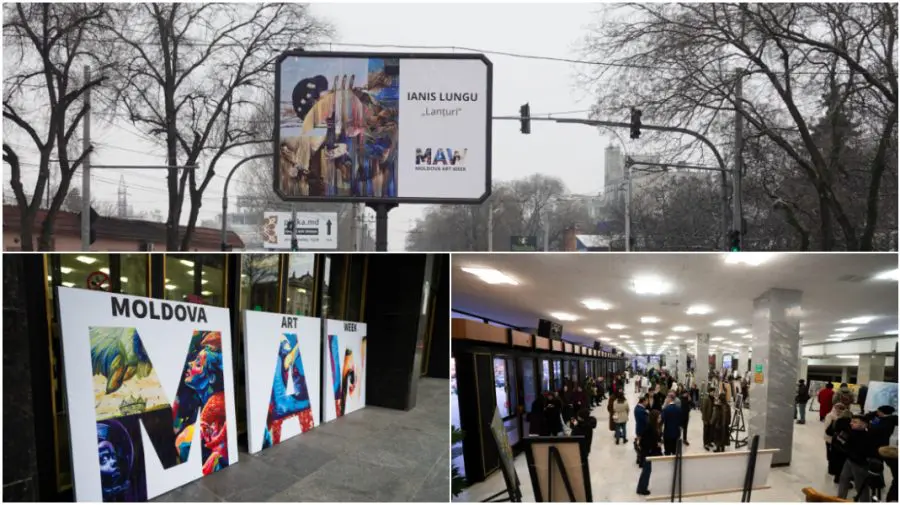
For one month every winter, Moldova’s capital turns its billboards into an open-air art exhibition. No tickets. No opening hours. No barriers. Just paintings where ads used to be.
Walk through central Chisinau in late March and something is still slightly off. The billboards look different. A month after the official closing of Moldova Art Week’s second edition, paintings are still up on some billboards across the city — a quiet sign that the project has outlived its official timeline.
This is Moldova Art Week, now in its second edition. And if the numbers are any guide, the city has noticed: an estimated four million billboard impressions across Chisinau and Balti during February 2026. Seventeen companies donated advertising space or radio airtime. All of it free — and entirely voluntary.
“The whole city of Chisinau has become an art space. Every billboard is a painting. Every passerby becomes part of the exhibition.”
That description comes from Maria Iurskaia, one of the 104 artists who participated in this year’s edition. It captures something real: MAW is not a gallery event with a vernissage and a closing night. It’s a month-long transformation of public space.
The man behind the idea
Andrei Jicol founded Moldova Art Week. He runs an outdoor advertising company with over 15 years in the industry — which means he manages a significant share of the city’s billboard network in Chisinau. He also finances the project personally.
His relationship with the city’s visual landscape goes beyond business. Jicol has been involved in developing the urban design codes for both Chisinau and Balti — documents that define how advertising integrates into public space, how streets maintain visual coherence, how a city communicates rather than shouts. He has also participated in working groups for advertising legislation at the national level.
This background gives MAW a different weight. This is not a case of a businessman casually entering the cultural space. It is someone who has spent years thinking about what cities look like — and who decided that the infrastructure he built could do more than sell products.
“The outdoor advertising business works with people’s attention. Having so much of the city’s attention at our disposal, it would be wrong not to use some of it to bring art closer to people.”
What the artists say
Ashot Pashinyan, another participating artist, frames the project in terms of attention economy: “The world is hooked on phones. Sometimes it’s worth stepping outside and seeing something colorful.” He describes MAW as an “open mic for artists” — a platform with no gatekeeping, where anyone with work to show can show it.
That openness is deliberate. In this edition, every artist who applied was accepted – no jury, no selection criteria. The result is a cross-section of Moldovan contemporary art: beginners alongside artists with 30 or 40 years of experience, traditional oil paintings alongside digital work and photography.
Five works were sold during the event, priced between 250 to 9,000 euros. Artists have already requested the creation of a marketplace platform for Moldovan art.
The audio layer
One of the distinctive features of MAW is a radio component complementing the visual exhibition. During February, 11 partner radio stations broadcast approximately 1,000 minutes of audio descriptions of the works on display — narrated context for paintings people were seeing on their commute.
Moldova’s Minister of Culture, Cristian Jardan, was particularly struck by this combination. “We invented something new”, Jicol says. “A mix of audio and visual that makes art more accessible.”
Looking Ahead to 2027
The third edition, planned for February 2027, marks a significant expansion. Jicol’s vision: art that begins at the country’s border. Travelers landing at Chisinau airport should encounter art immediately. Throughout MAW week, every restaurant, cafe, underground passage and park in Chisinau should be part of the exhibition.
The target: 300 advertising surfaces, international artists invited to participate (requests have already arrived from Romania and other countries), and a permanent MAW Residence where two to three international artists can work in Chisinau each year.
“I didn’t draw inspiration from any particular city. The ideas for Moldova Art Week come from inside. What Chisinau has is a community of artists ready to support, and a business community ready to get involved without money — on the basis of ideas alone.”