



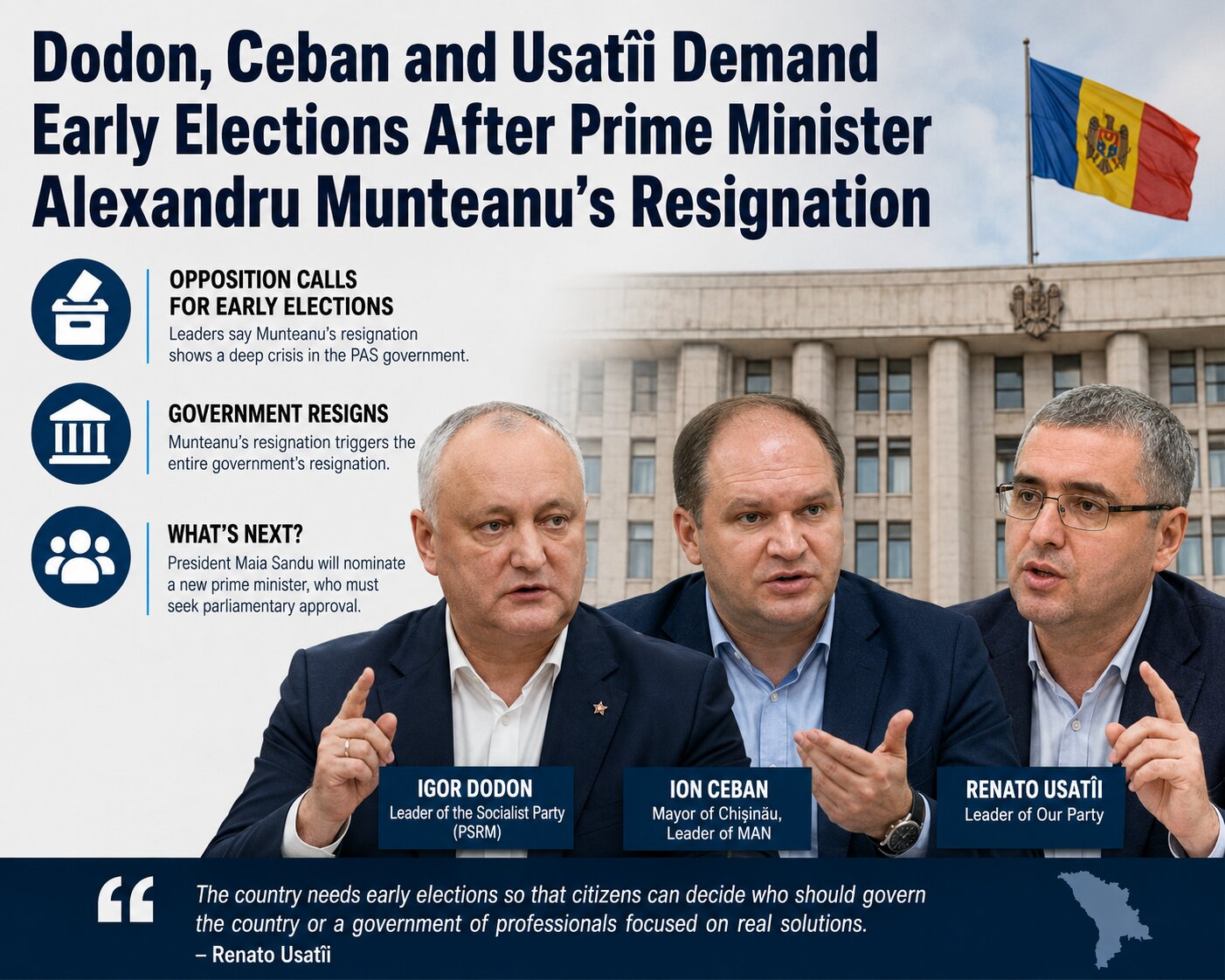
Leaders of Moldova’s opposition have called for early parliamentary elections following the resignation of Prime Minister Alexandru Munteanu, arguing that his departure reflects a broader crisis within the ruling Party of Action and Solidarity (PAS).
Munteanu announced his resignation on Friday, July 3, in a post on Facebook, saying he was ending his term as prime minister after accepting the position “with great responsibility and the firm conviction” that he could help improve the situation in the country.
The announcement prompted immediate reactions from opposition politicians, who described the resignation as evidence of the government’s failure and renewed calls for a snap parliamentary vote.
Socialist Party (PSRM) leader Igor Dodon said Munteanu had made “the right decision” by leaving what he described as a “rotten ship.”
“The first heavy piece of a domino chain called the PAS government has fallen,” Dodon wrote on social media. “This is only the beginning of the end of the most cynical, hypocritical and corrupt government in the country’s history. Society is waiting for and demanding early elections.”
Chisinau Mayor and National Alternative Movement (MAN) leader Ion Ceban also argued that the entire government should step down.
“I saw the announcement about the resignation. The whole government must resign. Early elections must be organized,” Ceban said in a social media post. He claimed Moldova is facing an “extremely serious” economic and social situation, accusing the authorities of corruption, failed reforms and incompetence. “What happened over the last year and the last five years shows they are the most incompetent and corrupt. Probably the man simply couldn’t take it anymore,” he added.
Meanwhile, Our Party leader Renato Usatîi said replacing one prime minister with another within the same governing system would not resolve Moldova’s problems.
“The resignation of the prime minister, by itself, does not solve the country’s main problem,” Usatîi wrote. He argued that Moldova needs either early parliamentary elections “so that citizens can decide who should govern the country” or a government of professionals made up of competent and experienced individuals regardless of political affiliation.
Usatii also called on the future prime minister to establish an urgent working group involving parliamentary factions, extra-parliamentary parties and sector experts to draft a National Governance Program addressing the country’s economic, social and security challenges.
Under Moldovan law, the resignation of the prime minister automatically triggers the resignation of the entire government, which continues to serve in a caretaker capacity until a new cabinet is appointed. President Maia Sandu is expected to nominate a new candidate for prime minister, who must then seek parliamentary approval.