



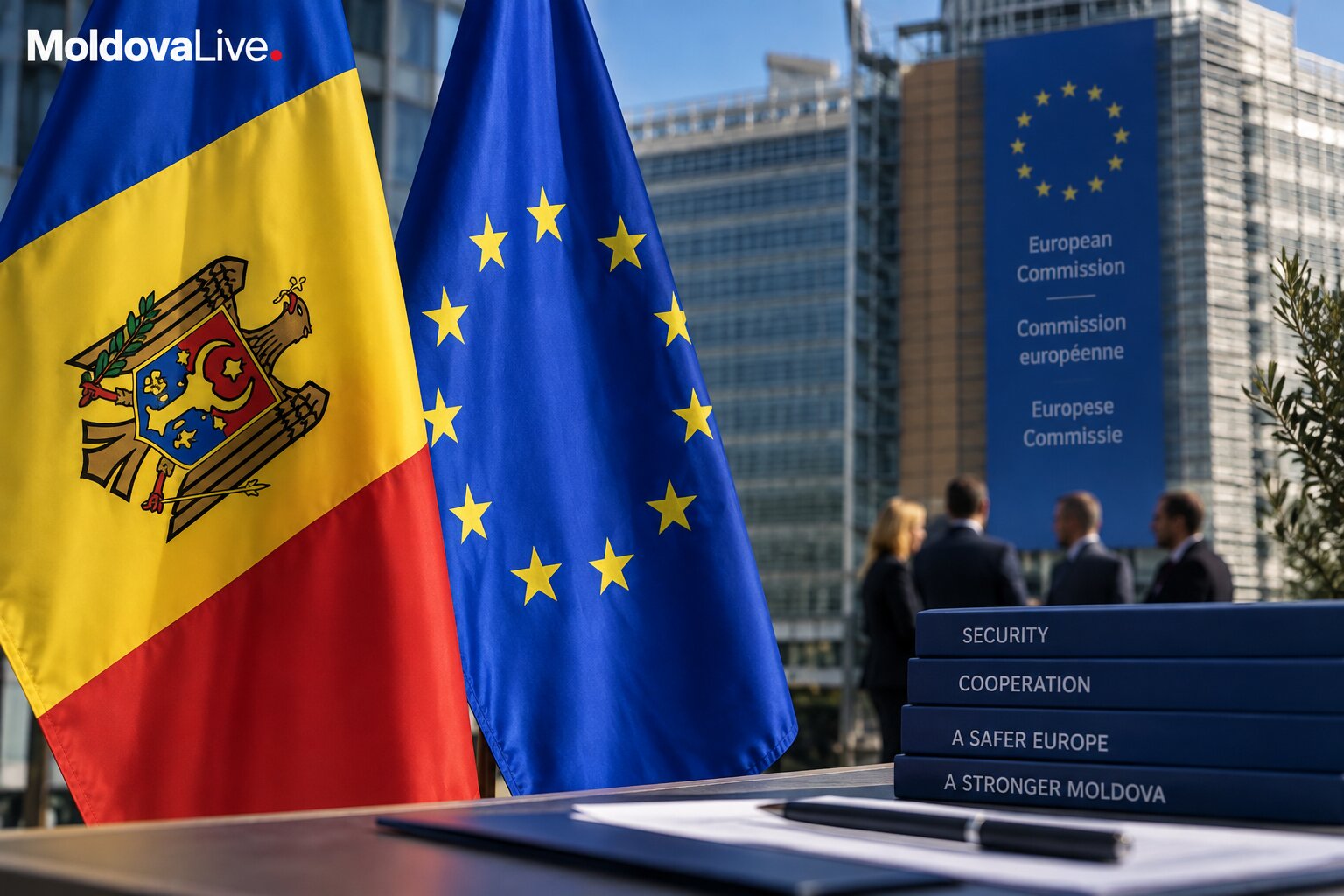
The Republic of Moldova is strengthening its role in the European security architecture as authorities step up cooperation with the European Union to combat drug trafficking and address emerging threats.
The 15th Conference of the EU Security Hub for Internal Security and Border Management in Moldova brought together national institutions, the European Commission, the EU Delegation, specialized European agencies and representatives of EU member states in Chisinau to discuss the growing threat posed by drug trafficking.
As new substances, routes and distribution methods continue to emerge, Moldovan authorities say closer cooperation with European partners is becoming increasingly important.
Daniella Misail-Nichitin, Minister of Internal Affairs, said the drug market is rapidly changing, with criminal networks adopting new technologies and methods to evade law enforcement.
“The drug market is changing. New substances are emerging, stronger and harder to identify. Criminal networks are changing their routes. They use online platforms, encrypted communications, postal and courier services, and are constantly looking for new ways to evade controls,” Misail-Nichitin said.
She added that Moldova is developing its systems for combating drug trafficking as part of the common European security space.
“Our direction is clear: the Republic of Moldova is building its drug trafficking enforcement systems as part of the common European security space. This is also important from the perspective of the Republic of Moldova’s accession to the European Union,” the minister said.
European officials also highlighted the growing involvement of young people and minors in drug trafficking and distribution.
Floriana Sipala, Director-Coordinator for Internal Security and Counter-Terrorism at the European Commission’s Directorate-General for Migration and Home Affairs, said the involvement of children and young people is becoming an increasingly worrying trend.
“One phenomenon that is becoming increasingly concerning in the European Union is the involvement of young people, minors and even children in drug trafficking and distribution. And, of course, the digital dimension plays a very important role in this whole phenomenon,” Sipala said.
The Security Hub is intended to turn dialogue between Moldova and the European Union into practical, operational cooperation. Rapid information exchange, cross-border investigations and access to European expertise and mechanisms are becoming increasingly important as criminal networks operate across several countries and constantly change their routes.
Jean-Philippe Lecouffe, Deputy Executive Director for Operations at Europol, said Moldova has reported increasingly large seizures of synthetic drugs in recent years and is becoming an important transit country.
“In recent years, Moldova has reported the seizure of increasingly large, sometimes significant, quantities of synthetic drugs. We see that Moldova is playing the role of a transit country,” Lecouffe said.
He linked the development to the closure of the port of Odesa and the war in Ukraine, which have created the need for alternative trafficking routes.
“This is also linked to the closure of the port of Odesa, the war in Ukraine and the need to identify alternative routes. And young people are being used for this. If we fight drug trafficking, at the same time we are also protecting young people,” Lecouffe said.
Mate Csicsai, Deputy Head of the Delegation of the European Union to Moldova, described drug trafficking as a major challenge for European security and said the EU was ready to continue supporting Moldova.
“Drug trafficking unfortunately remains a major challenge for Europe’s security. The authorities of the Republic of Moldova have made important progress in this area under difficult circumstances and are making considerable efforts to combat drug trafficking,” Csicsai said.
He added that continued EU support would benefit not only Moldova but the entire European Union.
“Of course, the European Union is ready to continue supporting these efforts, because this does not only mean good news for the safety and security of the citizens of the Republic of Moldova, but also for citizens throughout the European Union,” he said.
For Moldova, the next stage involves strengthening its detection and investigation capabilities, while also deepening integration into European information-sharing mechanisms.
The Police and Border Police presented their operational results, newly identified risks and the capabilities they say need to be developed to allow institutions to respond more quickly to trafficking networks.
Viorel Cernăuțeanu, Head of the General Inspectorate of Police, said the number of drug-related criminal cases has increased significantly in recent years.
“The latest destruction of drugs carried out by police subdivisions took place on August 25. In the first seven months of 2024, there were 631 drug-related criminal cases. In the first seven months of 2025, there were 757, while in the first seven months of this year, we have 986 criminal cases,” Cernăuțeanu said.
He also announced plans to expand the police’s technical capabilities by acquiring four chromatographs.
“We want to expand our equipment with four chromatographs — one in Cahul, one in Balti and two in Chisinau — which would increase the number of expert reports related to drugs,” Cernăuțeanu said.
The Border Police is also playing a key role in identifying trafficking routes and criminal networks.
Ruslan Galușca, Head of the Border Police, said the state border should be viewed not only as a control line, but also as an important source of information for identifying risks and combating transnational criminal networks.
“The state border should not be viewed merely as a line of control, but as an important point for identifying risks and generating relevant information to combat transnational criminal networks,” Galușca said.
He pointed to the results recorded by the Border Police in 2025.
“In 2025, we detected 91 cases of illicit drug trafficking, seized approximately 67 kilograms of drugs and 210 kilograms of precursors, and detained eight criminal groups involved in these illicit activities,” Galușca said.
The estimated value of the seized goods was around 3 million euros, he added.
European cooperation, however, extends beyond intercepting trafficking routes and seizing drugs. Moldova is also working to strengthen its ability to identify new substances and emerging risks before they spread.
This includes developing an early warning system and increasing access to European expertise and mechanisms.
Lorraine Nolan, Executive Director of the European Union Drugs Agency (EUDA), said the agency was ready to support Moldova throughout the process.
“EUDA is ready to support the Republic of Moldova throughout the entire process, not only by providing a universal methodology, but by working together with Moldovan institutions to build systems adapted to your national needs, while also aligned with European standards and European cooperation mechanisms,” Nolan said.
The fight against drug trafficking is therefore becoming an increasingly important part of Moldova’s integration into the European security space.
From timely information exchange and the detection of new substances to investigations and cross-border operations, Moldovan and European authorities say their objective is the same: to disrupt criminal networks before drugs reach communities and young people.
The 15th Security Hub Conference highlighted the shift from dialogue to practical cooperation, with institutions working more closely together and developing modern capabilities to respond to a threat that does not stop at national borders.
For Moldova and its European partners, every trafficking route identified, every dangerous substance detected in time and every criminal network dismantled represents another step toward greater security for Moldovan citizens and the wider European space.