



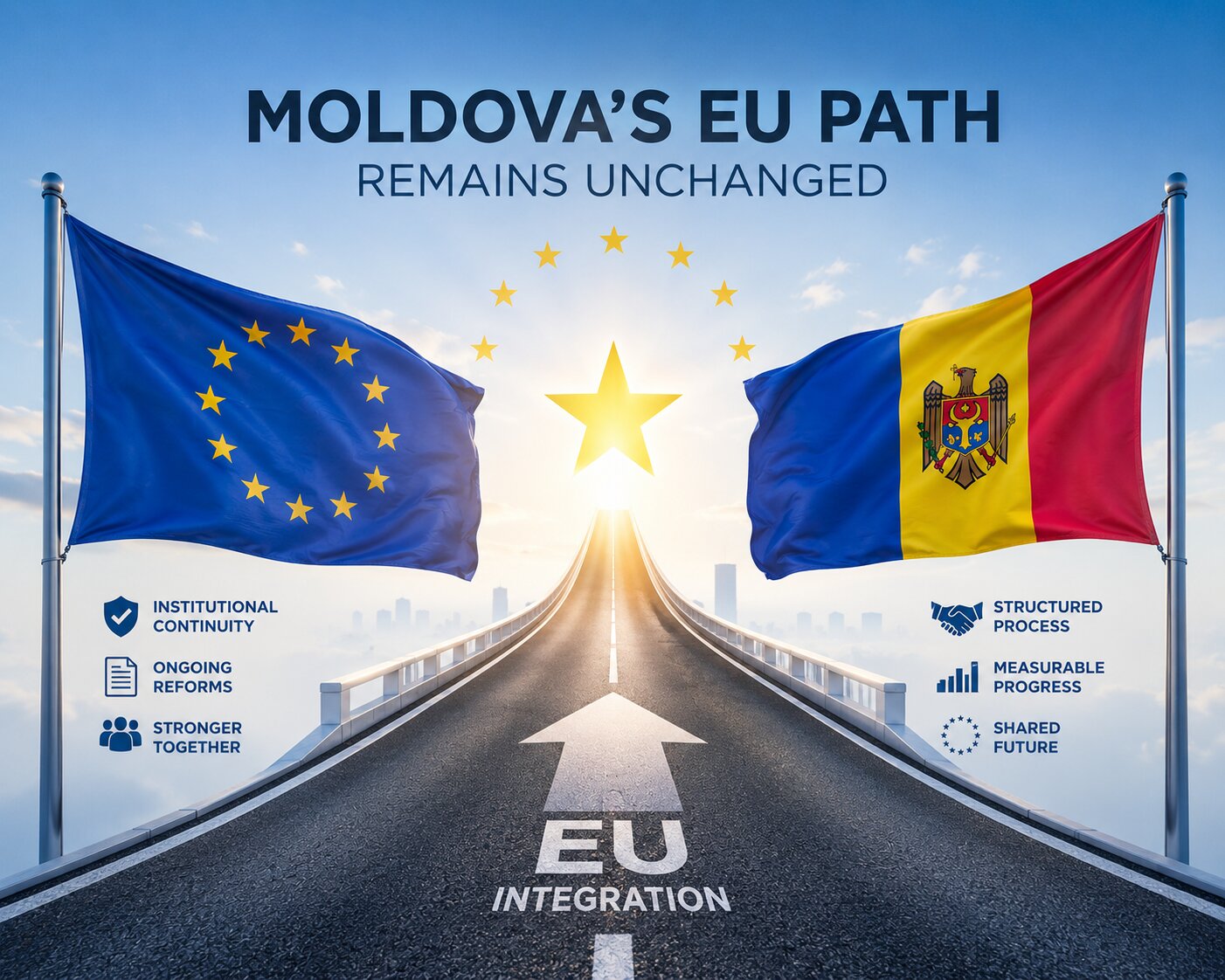
The resignation of a prime minister naturally raises political questions, but in the context of Moldova’s European integration, one key point is often overlooked: the country’s strategic direction is already defined and operates through state institutions, not individual political figures.
European integration is not a project of a single government or a personal initiative of a prime minister. It is a long-term institutional process that continues regardless of changes in executive leadership.
In other words, government reshuffles may influence the pace of certain decisions, but they do not change the country’s direction of travel.
EU integration is already structurally embedded
In recent years, Moldova has taken several decisive steps that have fundamentally reshaped its relationship with the European Union:
- obtaining EU candidate status
- launching formal accession negotiations
- beginning the screening of national legislation
- aligning key sectors with the EU acquis
- expanding financial and technical support from the EU
These developments mean that European integration is no longer a political slogan, but a structured state policy embedded in institutions and long-term obligations.
Once accession negotiations formally begin, the process becomes rule-based and institution-driven rather than personality-driven.
Why the process continues regardless of government changes
EU accession negotiations are not conducted as a bilateral political dialogue between a prime minister and EU leaders. Instead, they function as a multi-layered institutional process involving:
- national government ministries
- the parliament
- the Bureau for European Integration
- dozens of technical working groups and experts
- the European Commission and EU institutions
This system is specifically designed to ensure continuity across political cycles.
As a result, the resignation of a prime minister does not reset, pause, or suspend the accession process.
The EU evaluates institutions, not individuals
A core principle of EU enlargement policy is institutional continuity.
The European Commission assesses progress based on:
- independence of the judiciary
- effectiveness of anti-corruption institutions
- functioning of public administration
- implementation of adopted reforms
- consistency of legal alignment with EU standards
Changes in political leadership are considered part of normal democratic governance, while the main focus remains on whether institutions continue to function effectively.
What actually happens after a resignation
In most cases, the technical work related to EU integration continues without interruption:
- negotiation teams continue their work
- legislative processes remain on track
- dialogue with the European Commission continues
- previously agreed commitments remain in force
- ongoing reforms continue to be monitored
Even during transitional political periods, the administrative system continues to operate within the established framework.
Why Moldova’s EU path is structurally stable
Moldova is already formally inside the EU accession framework, which means:
- the strategic direction is officially defined
- reform priorities are set in negotiation documents
- progress is continuously monitored by the EU
- financial and technical assistance is tied to reforms
This creates a system where continuity is built into the process itself.
As a result, internal political changes do not alter the country’s European trajectory.
European experience confirms this pattern
Across EU enlargement history, changes of government in candidate countries are common and expected.
However, as long as the overall reform direction is maintained:
- negotiations continue
- technical work does not stop
- accession frameworks remain intact
The EU consistently prioritises institutional stability over individual political leadership.
The resignation of a prime minister does not affect Moldova’s European integration path.
The country is already engaged in a formal, structured accession process where progress is determined by institutional performance rather than political leadership changes.
As long as state institutions continue to function and reforms remain on track, Moldova’s EU trajectory remains stable and unchanged.
In this sense, political transitions are part of the democratic process, while European integration operates as a long-term institutional framework that continues beyond individual governments.