


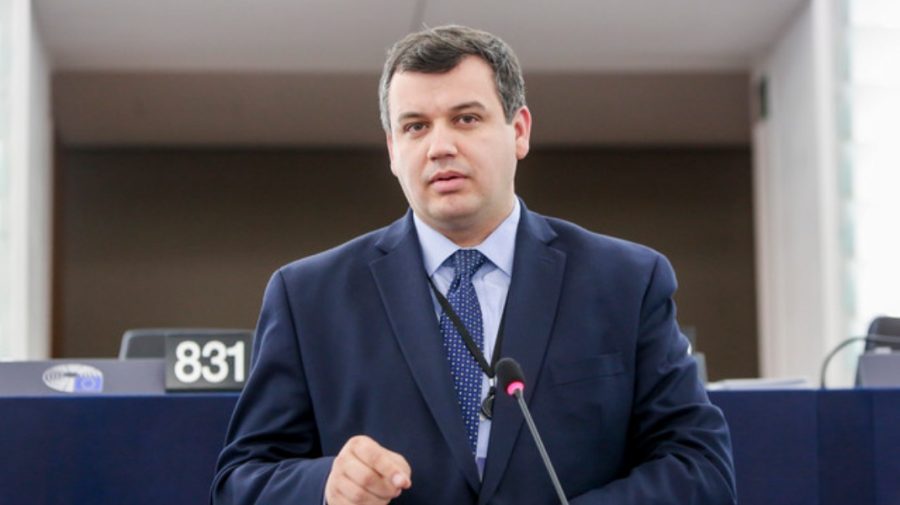
Romanian MEP Eugen Tomac said that a smart policy of reconnecting the two banks of the Dniester through more joint economic projects and social partnerships, while avoiding ideological disputes, will create the right climate for people to increasingly want to join the European Union. He made the statement in an interview with RFI. Tomac serves as an honorary adviser to the President of Romania on relations with Romanians abroad. His comments come amid recent statements by Moldovan officials about a possible decoupling of Moldova’s European integration process from the country’s reintegration process.
“This issue is inseparable from the integration process itself. Several factors can complicate negotiations or, on the contrary, help them. I believe that internal reforms will help all regions of the Republic of Moldova, not only Transnistria, understand how much citizens can benefit from European integration. I also refer to Gagauzia and the northern districts, where public opinion remains extremely reserved about the European integration process,” Eugen Tomac, a member of the Renew Europe group, told RFI.
According to Tomac, the Transnistrian region, although under strong control by the Russian Federation and maintained as an artificial entity that seeks to politically disrupt the integration process, will see most of its citizens increasingly notice the benefits of European integration.
“I am absolutely convinced that a smart policy of reconnecting the two banks of the Dniester, through more joint economic projects and social partnerships that avoid ideological disputes, will create the necessary climate for people to increasingly want to be part of the European Union,” Tomac reiterated.
At the same time, Eugen Tomac said that, compared with other European examples such as Cyprus, the situation in the Republic of Moldova regarding the separatist Transnistrian region is significantly better.
“There are contacts, concrete steps along the path of dialogue, and a much healthier perspective for rebuilding connections between the two banks, through a phased process toward accession to the European Union,” he said.
Tomac stressed that authorities must treat the issue with seriousness and caution, noting that those who promote distancing from Chisinau and maintain tension act in line with Moscow’s demands.
“Perhaps after the end of the war in Ukraine, conditions could emerge for this area controlled by the Russian Federation to change its perspective. However, it is very difficult to estimate how the situation will evolve, as long as the final signal ultimately comes from Moscow,” the Romanian MEP added.
Recently, at a national conference on human rights on the left bank of the Dniester, Moldova’s Deputy Prime Minister for Reintegration Valeriu Chiveri said that the Republic of Moldova could decouple its European integration process from the reintegration process in order to ensure a systemic, responsible, and calm approach to reintegration.
According to Chiveri, the country’s reintegration process may take longer than Moldova’s European integration process.