



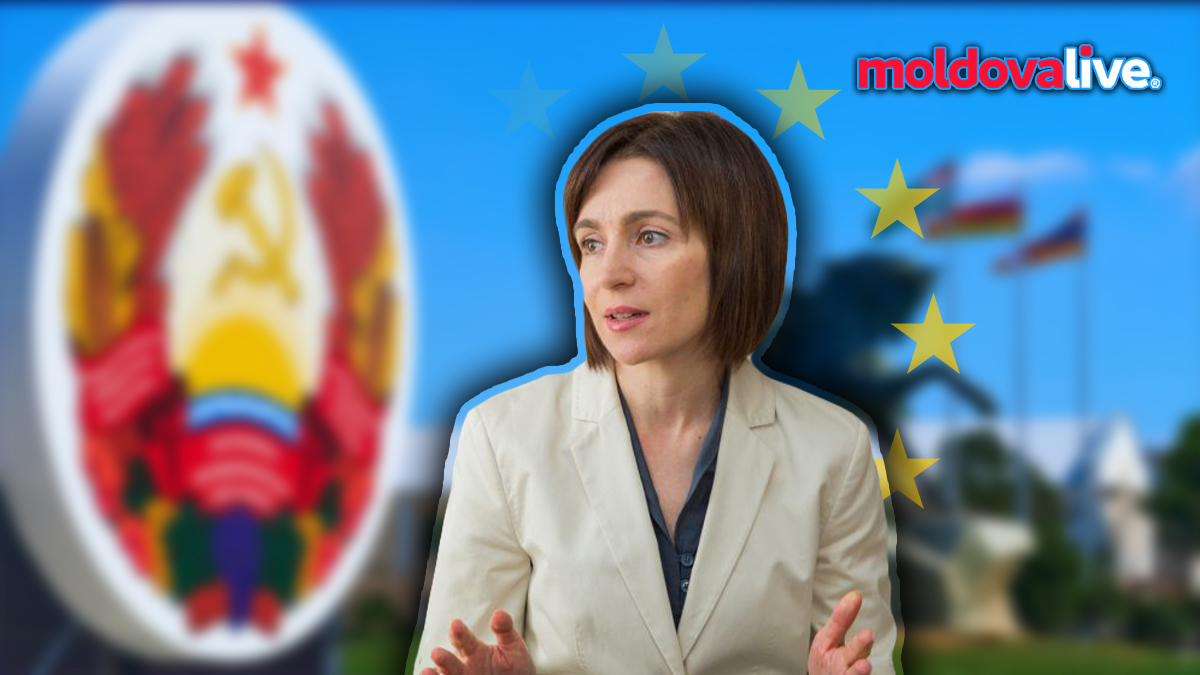
President Maia Sandu stated that the reintegration of the Transnistrian region requires a period of demilitarization, de-oligarchization, and democratization, emphasizing that such a process cannot happen quickly. She referred to the left bank of the Dniester River when outlining these conditions.
She made the remarks in connection with a document recently circulated in the public space that proposes gradual reintegration measures. Sandu explained that the initiative remains at an early stage and depends on the involvement of external partners, particularly the European Union.
“This idea from the Government is meant precisely to address the issue during the period of demilitarization, democratization, and de-oligarchization. It is at an early stage of discussion with the European Union, because it is clear that we also need the commitment of our partners,” the president said.
She stressed that authorities will advance only after securing clearer commitments from development partners.
“And when we have a more substantial discussion and a potential commitment from our partners, then, of course, we will move forward,” she added.
Sandu also suggested that the administration in Tiraspol may eventually have to accept such solutions due to growing difficulties faced by the population.
“I don’t think the regime in Tiraspol has many options, because we see what is happening to the people there. They need basic living conditions—food, heating, education. When the regime can no longer provide these, it will have to look for other solutions. The solution comes from the European Union,” the president said.
Recently, journalist Vladimir Solovyov published what he claimed to be a reintegration plan for the Republic of Moldova on social media, while Deputy Prime Minister for Reintegration Valeriu Chiveri was on an official visit to Brussels.
The 14-page document, written in English, outlines a 2026 action plan with 25 measures covering areas such as the economy, political dialogue, mobility, and efforts to prevent destabilization, escalation, and disinformation.
After returning to Chisinau, Chiveri confirmed the document’s authenticity, describing it as a “non-paper” intended to serve as a starting point for discussions with international partners involved in the reintegration process.