



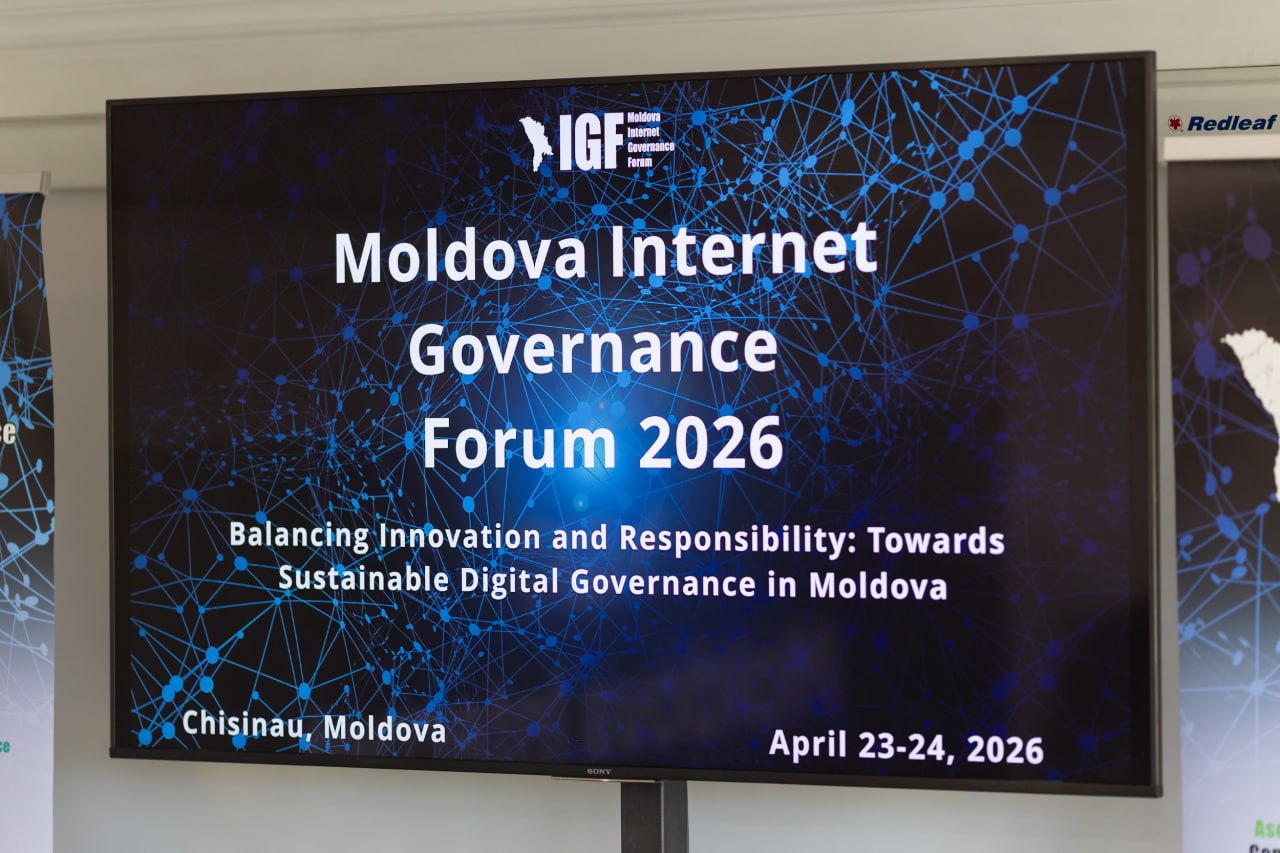
The sixth edition of the Moldova Internet Governance Forum (MIGF 2026) took place in Chisinau, serving as a national platform for open dialogue on the future of the internet and digital policy in the country. Participants discussed issues that directly affect both society and public institutions, including digital ecosystem resilience, infrastructure security, digital rights, inclusive access, and challenges linked to emerging technologies.
The event was held on 23–24 April in a hybrid format, bringing together more than 40 national and international experts, along with representatives of partner organisations, public institutions, the technical community, business, and civil society. In addition to those present in the room, the discussions were followed by a broad online audience from dozens of countries.
At the opening session, Anja Gengo from the UN IGF Secretariat provided an overview of key global internet governance processes and highlighted their connection with MIGF and other national dialogue platforms. She noted that, as of 2026, the mandate of the IGF has been placed on a permanent footing. David Frautschy, Senior Director for European Government and Regulatory Affairs at the Internet Society, observed that over the past six years, MIGF has established itself as a key multistakeholder space for open dialogue, where global internet governance trends are translated into the national context.
Sergiu Gaibu, Director of the National Regulatory Agency for Communications (ARCOM), reaffirmed the importance of strengthening a secure, open, and resilient digital ecosystem amid accelerated technological transformation and international challenges, including those specific to the region. He underscored the central role of cooperation among public authorities, the private sector, academia, and civil society in shaping digital policy, stressing that internet governance must be grounded in inclusive and multistakeholder dialogue.
As noted by Alexei Marciuc, Chairman of the Association “Comunitatea Internet” and National coordinator of MIGF, the digital agenda has long moved beyond a purely technical framing: “Internet governance issues are, above all, about trust, security, and whether the environment being built responds to the real needs of people.” He also drew attention to the importance of building an architecture of trust, in which innovation is inseparable from the protection of users’ fundamental rights.
The first session of the forum, dedicated to the European digital agenda and the development of a resilient ecosystem in Moldova, brought together representatives of international partners, the Ministry of Economic Development and Digitalization, ARCOM, the National Association of ICT Companies (ATIC), ICI Bucharest, and “Dunarea de Jos” University of Galati. According to the speakers, advancing Moldova’s digital transformation towards 2030 requires not only improvements to the legal and regulatory framework, but also the preparation of a new generation of professionals able to work at the intersection of technology, regulation, security, and the public interest. Participants discussed how cross-border cooperation and knowledge exchange can help strengthen local expertise in cybersecurity, artificial intelligence, and emerging digital standards.
The discussion on secure and transparent digital infrastructure in a challenging geopolitical environment brought together representatives of the national regulator, the Special Telecommunications Service, Moldcell, ATIC, Digital Flower, and cybersecurity specialists. The exchange focused on practical dimensions of resilience, ranging from routing transparency and the reliability of interconnection to network architecture vulnerabilities and coordination among relevant stakeholders. Participants concluded that cyber resilience of critical communications in the age of AI is only possible through close cooperation among the state, communications operators, and international security partners.
Issues of inclusive access and digital rights were addressed in a session featuring ARCOM, IT companies, civil society, and specialised organisations from different countries that raised concerns related to digital inequality, including Access Now, Female Support Force, the Association of Entrepreneurs with Disabilities, Dahr, and the Internet Society Kyrgyzstan. Representatives of communities directly affected by digital barriers also joined the discussion.
The exchange showed that meaningful participation in digital society remains limited for vulnerable groups, including people living in rural areas, refugees, Roma communities, persons with disabilities, as well as women and girls, for whom digital barriers are often compounded by social and economic inequality. Experts agreed that Moldova needs regulatory approaches centred on communities and partnerships that ensure not merely “connection,” but meaningful, safe, and non-discriminatory access to technology.
The final thematic session focused on “Emerging Technologies and Cybercrime: Inclusive and Human-Centric Responses”. Specialists from the Prosecutor General’s Office, Moldova State University, the Centre for Combating Cybercrime, the Superior Council of Prosecutors, CNPAC, and independent experts discussed risks related to AI-enabled fraud and online exploitation. Participants stressed the importance of a human-centric approach: prevention and investigation systems must be oriented toward protecting affected individuals, while improving cyber literacy remains one of the most effective safeguards against technology-enabled abuse.
A separate component of the programme took place as the side event Moldova Universal Acceptance Day 2026, dedicated to universal acceptance, the multilingual internet and the accessibility of digital services. This thematic track complemented the broader MIGF 2026 agenda by underscoring that today’s digital environment must be not only technologically advanced, but also accessible to users with diverse linguistic, technical, and social needs. At the opening of the event, representatives of the Moldovan e-Governance Agency and the Prime Minister’s Office emphasised that the accessibility of digital services and technical compatibility are becoming essential conditions for effective digital transformation.
In closing the sixth edition of MIGF, the organisers noted that the conclusions and recommendations developed through the event will be published on official platforms and presented at the United Nations Internet Governance Forum, which will take place in Nairobi, Kenya, in December 2026.
The General Media Partner of the Internet Governance Forum in Moldova was Realitatea Media Group.


