A 21-year-old employee of Moldova’s Ministry of Culture has come under public scrutiny after an investigation by Moldova Curată reported that he earns approximately 300,000 lei per year through service contracts and advisory work.
According to the investigation, Bogdan Zgherea joined the Ministry of Culture in 2023 while he was a first-year university student. He initially worked under service contracts awarded without a public tender.
Between August 2024 and August 2025, at the age of 19, Zgherea was appointed as an adviser in the cabinet of then-Culture Minister Sergiu Prodan. He later returned to working under service contracts after ministry officials concluded that he had not yet completed the bachelor’s degree required for a public service position.
The Ministry of Culture denied that Zgherea’s employment was linked to his political affiliation with the ruling PAS party. The Anti-Corruption Prosecutor’s Office also reviewed the case in December 2025 for possible abuse of office but said it found no evidence of criminal wrongdoing.
Zgherea graduated from the National College of Commerce of the Academy of Economic Studies of Moldova in 2023. That same year, he joined PAS and became a member of the party’s youth organization.
From April to August 2023, when he was 17, he worked as an assistant to PAS MP Ana Calinici. The lawmaker said she selected him because of his skills and ability to perform technical tasks of limited complexity, adding that he received a monthly salary of 6,000 lei.
Current Culture Minister Cristian Jardan told the publication that Zgherea holds a valid service contract running until the end of 2026 and receives annual remuneration of approximately 300,000 lei.
Former Culture Minister Sergiu Prodan said he decided to appoint Zgherea as an adviser after his previous service contract expired, noting that adviser positions do not require a competitive recruitment process and are based on the confidence of the public official making the appointment.
Prodan said ministry officials later informed him that Zgherea could not legally remain in the position because he had not yet completed his bachelor’s degree.
According to Moldova Curată, documents from the criminal investigation show that the ministry’s human resources department raised concerns over the appointment, after which Prodan submitted a written note praising Zgherea’s work and contributions to ministry projects.
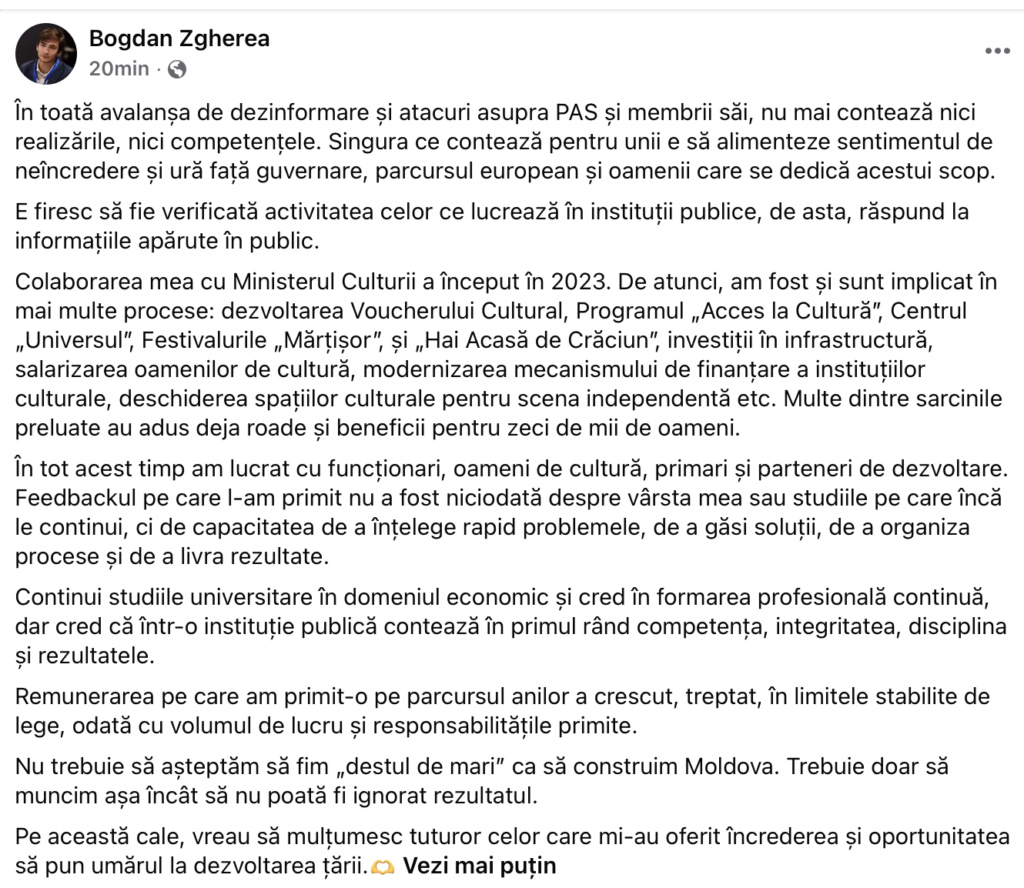
In a statement published on social media, Zgherea defended his record, saying he has contributed to several major initiatives since joining the ministry, including the Cultural Voucher program, the “Access to Culture” program, the “Universul” Center, the “Martisor” and “Come Home for Christmas” festivals, cultural infrastructure investments, salary reforms for cultural workers, and changes to cultural funding mechanisms.
He said his work has been judged by results rather than his age or unfinished university studies.
“I continue my university studies in economics and believe in continuous professional development, but I also believe that competence, integrity, discipline, and results are what matter most in public administration,” Zgherea wrote.
He also said that his remuneration increased gradually over the years, within the limits established by law, in line with his growing responsibilities and workload.