



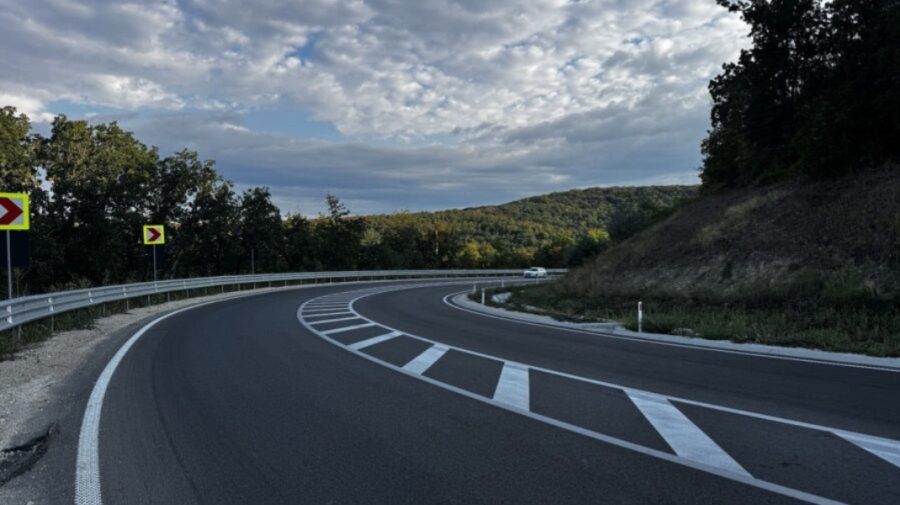
Visible cracks have appeared in sections of the R33 Hincesti-Lapusna-M1 republican road, which is still undergoing rehabilitation. The works are being carried out by Turkish company ONUR Taahhut Tasimacilik Insaat Ticaret ve Sanayi A.S. under a contract worth nearly EUR 38.75 million, Bani.md reports.
Photographs sent to the Bani.md editorial team show several longitudinal and branching cracks on the newly paved surface. Some are already pronounced enough to be clearly visible to the naked eye. However, the technical cause of the cracking cannot be determined from photographs alone and would require an on-site technical assessment.
The situation has drawn attention because the project has not yet been completed. The National Road Administration previously announced that rehabilitation works on the 37.2-kilometer R33 began in April 2024, with completion scheduled for October 2026. As recently as June, works were still underway on some sections, including in Hincesti, where the final wearing course was being laid.
The contract with ONUR was signed on December 12, 2023, and is worth EUR 38.746 million. Financed with support from the European Bank for Reconstruction and Development (EBRD), the project involves the full rehabilitation of the road between Hincesti and its junction with the M1, including bridge works, drainage systems and improvements to the road structure.
The appearance of the cracks comes as ONUR is expanding its ambitions in Moldova’s road infrastructure market. According to information obtained by Bani.md, the company is also interested in the rehabilitation project for the M1 Leuseni-Chisinau road, one of Moldova’s most important transport corridors.
The tender for the first two M1 lots is already underway. They cover the km 1-9 and km 9-39 sections, with bids due by September 30, 2026. The project is also financed by the EBRD.
However, ONUR faces an additional issue in relation to the project. In May 2026, the EBRD sanctioned ONUR and 53 of its subsidiaries over collusive practices identified in a bank-financed procurement procedure in Ukraine.
ONUR acknowledged responsibility and cooperated with the investigation. The sanction includes a one-year and three-month period of ineligibility, followed by two years of conditional non-exclusion. During the exclusion period, the company and the affected subsidiaries are not eligible for new projects financed by the EBRD.
As a result, while ONUR has expressed interest in the Chisinau-Leuseni road rehabilitation project, its current EBRD sanction presents a direct obstacle to participation in contracts financed by the institution during the exclusion period.
ONUR already has a significant presence in Moldova’s road infrastructure market. In addition to the R33 project, the company has previously secured contracts for other national roads, including a section of the R14.
The cracks now visible on the R33 raise questions about the quality of the works and how any defects will be addressed before the road is formally accepted.
Without a technical assessment or an official explanation from the National Road Administration and the contractor, it is not yet possible to determine whether the cracks are a localized, superficial issue or a more serious defect requiring extensive repairs.