



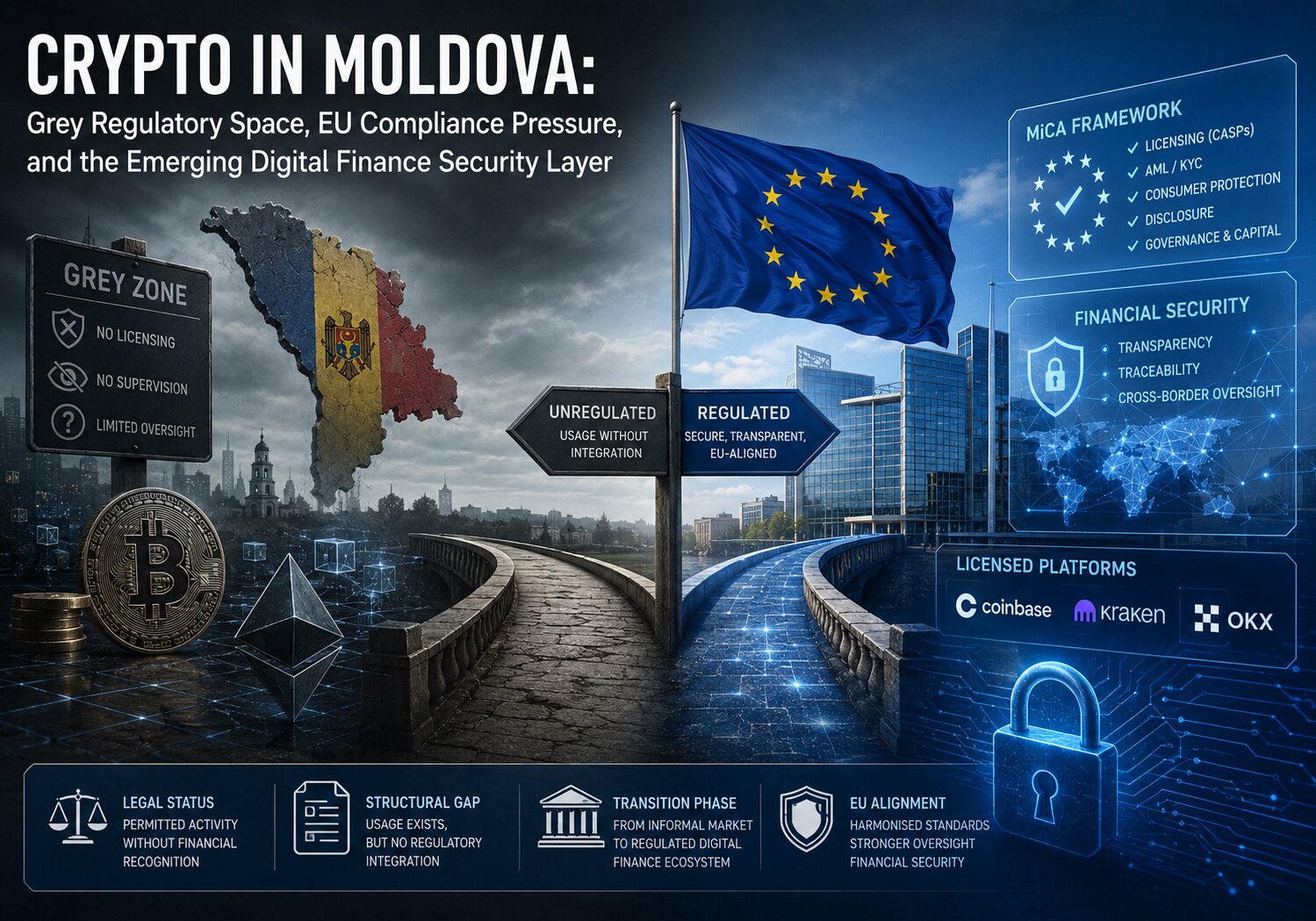
Cryptocurrency in Moldova operates in a legally undefined environment: it is not banned, but it is not regulated as a financial sector either. This creates a structural “grey zone” where ownership is permitted, while services, exchanges, and intermediaries remain outside a dedicated licensing framework.
At the same time, Moldova is gradually aligning its financial legislation with European Union standards, which are becoming increasingly strict and harmonised across the bloc. The result is a widening gap between real-world crypto usage and the regulatory system that is expected to govern it.
1. Legal status: permitted activity without financial recognition
In Moldova, crypto-assets are not recognised as legal tender. The National Bank of Moldova maintains that virtual assets cannot be used as official means of payment and are not part of the national monetary system.
This places crypto in a category of private digital assets rather than regulated financial instruments. As a result:
- individuals can legally hold and trade crypto;
- crypto is not integrated into banking infrastructure;
- service providers operate without a dedicated licensing regime.
The absence of sector-specific regulation means that most crypto-related activity exists outside formal financial supervision.
2. EU regulatory framework: MiCA as the new benchmark
The European Union has introduced a comprehensive regulatory regime for crypto-assets known as the Markets in Crypto-Assets Regulation (MiCA), designed to standardise supervision across all member states.
Official EU documentation defines MiCA as a framework covering transparency, licensing, supervision, and consumer protection for crypto-asset service providers and issuers.
- European Securities and Markets Authority (ESMA)
- MiCA Regulation (EU legal framework)
- European Banking Authority (EBA)
MiCA introduces mandatory authorisation for crypto-asset service providers (CASPs), meaning that exchanges, custodians, and trading platforms must obtain a license to operate legally within the EU.
As of 2026, the framework is entering full enforcement phase, requiring compliance across all EU jurisdictions and creating a unified licensing system for crypto businesses operating in Europe.
3. Market consolidation under EU rules
The implementation of MiCA is already reshaping the European crypto market structure. Regulatory compliance requirements are significantly increasing entry barriers for smaller platforms, while strengthening the position of licensed global exchanges.
Large platforms that operate under formal regulatory frameworks include:
These companies operate within regulated or partially regulated jurisdictions and are actively adapting to EU licensing requirements.
The new regulatory environment is expected to reduce the number of non-compliant operators in the EU market and concentrate liquidity within licensed entities.
4. Regulatory pressure and systemic transparency requirements
MiCA introduces a unified compliance structure covering:
- licensing of crypto-asset service providers
- capital and governance requirements
- AML (anti-money laundering) and KYC obligations
- disclosure rules for token issuers
- consumer protection standards
This framework effectively shifts crypto from a decentralised market environment toward a supervised financial sector integrated into existing banking regulation.
The key policy objective is to reduce regulatory arbitrage between jurisdictions and increase traceability of digital asset flows across borders.
5. Moldova’s structural gap: usage without integration
Moldova’s current position contrasts sharply with the EU model. While crypto usage exists at the retail level, the country does not yet have:
- a licensing regime for exchanges or custodians
- a dedicated crypto taxation framework
- integrated reporting requirements for service providers
- full AML alignment specific to digital assets
This creates a structural asymmetry: cross-border flows can be executed through global platforms, while domestic regulatory oversight remains limited.
6. Geopolitical dimension: crypto as part of financial security policy
In the European regulatory model, crypto-assets are increasingly treated not only as financial instruments, but also as elements of financial security infrastructure.
The MiCA framework is part of a broader EU strategy aimed at:
- increasing transparency of cross-border capital flows
- reducing exposure to unregulated financial channels
- strengthening anti-money laundering enforcement
- harmonising financial oversight across member states
This means crypto regulation is no longer purely economic policy, but part of a wider governance and security framework.
7. Transition phase: from informal market to regulated ecosystem
Moldova is currently in a transitional stage where crypto-assets are widely accessible through global platforms, but not yet embedded in a structured regulatory system.
The expected adoption of EU-aligned legislation would significantly change this structure by introducing:
- mandatory licensing for crypto service providers
- formal tax treatment of digital assets
- compliance obligations aligned with EU standards
- integration of crypto activity into financial supervision systems
This would mark a shift from informal usage toward a regulated digital financial ecosystem.
Conclusion
Crypto in Moldova currently exists in a legal and institutional gap between market activity and regulatory absence. While usage is permitted, the sector is not formally integrated into financial oversight mechanisms.
At the same time, the European Union is moving toward a fully standardised regulatory system under MiCA, creating a high-compliance environment that will define access to the crypto market across Europe.
For Moldova, the central issue is not whether crypto exists as a market, but how quickly it will be integrated into a regulated financial framework aligned with EU standards — and how this transition will reshape its broader financial governance architecture.