



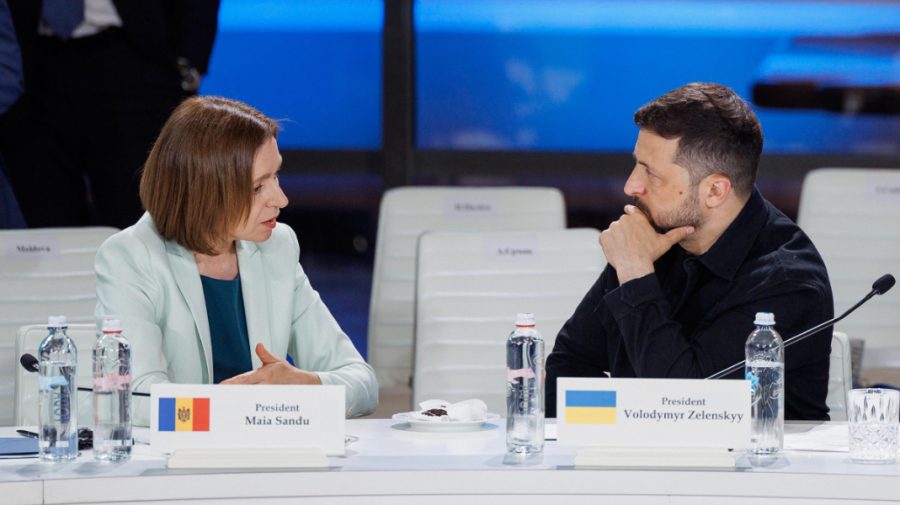
The European Commission is considering accession roadmaps for Moldova, Ukraine, Montenegro and Albania that would set out specific steps and target dates for advancing their bids to join the European Union, according to two senior EU officials involved in preparing the proposals, cited by Politico.
The four countries are considered to be among the candidates furthest along in the EU accession process. However, negotiations have continued at a slow pace, while there are still no clear deadlines for when they could become EU members.
The proposed roadmaps would, for the first time, provide a clearer commitment that countries meeting the required reform benchmarks could move toward accession. They would also include target dates for completing different stages of negotiations.
One of the officials said the roadmaps would clarify what is expected from each candidate while also creating commitments for current EU member states, whose approval is required for the accession process to move forward.
The plans would set target dates for completing groups of reforms known as negotiation clusters, which represent major stages in the EU accession process.
European Commission President Ursula von der Leyen pledged in her State of the Union address earlier this month to provide targeted support to candidate countries that have “made the most progress.”
A European Commission spokesperson confirmed that the proposed roadmaps would “provide a pathway towards the conclusion of accession negotiations.” According to the spokesperson, they would establish clear priorities, target dates and concrete objectives to help the most advanced candidates complete the necessary reforms.
A geopolitical imperative
The initiative comes as EU leaders increasingly look toward other democracies committed to free trade, particularly in the bloc’s neighborhood, amid tensions with partners such as the United States, competition from China and security threats posed by Russia.
European officials are concerned that the accession process is taking too long, potentially increasing frustration among candidate countries or leaving them more vulnerable to pressure from external powers seeking to pull them away from the European path.
The proposed roadmaps are being developed alongside a separate review of the EU’s pre-accession policy.
EU officials argue that candidate countries should be offered a clearer path toward “gradual integration” into the bloc, including economic benefits and participation in joint projects in return for progress on reforms.
The review, coordinated by Alexandre Adam, one of von der Leyen’s senior advisers, is expected to be presented to senior officials on October 6.
A preliminary version of the policy document seen by Politico describes enlargement as “a geopolitical imperative”, while stressing that accession itself requires time.
“Candidate countries need to go through a rigorous, merit-based process and implement comprehensive and sustainable reforms,” the draft says, according to Politico. It adds that this period should be used strategically both to prepare the EU for a larger membership and to deepen gradual integration in areas of mutual interest.
Safeguards for a larger EU
As part of the review, von der Leyen and European Commissioner for Enlargement Marta Kos are expected to propose changes to the way the EU functions internally, including safeguards intended to ensure that future members cannot disrupt key EU policies or fail to meet their commitments after joining.
Options under consideration reportedly include emergency clauses and transitional periods before new members receive certain rights associated with full membership, or after those rights have been granted.
The draft document argues that the EU can adapt to a larger membership largely within the existing treaty framework.
“The policy reviews show that the Union can integrate a large number of members through targeted adaptations, largely within the current treaty framework,” the document reportedly says.
EU governments remain cautious about admitting new members, particularly given concerns about the strength of democratic institutions and the rule of law in some candidate countries.
The experience of Hungary is among the factors influencing the debate. During the government of former Prime Minister Viktor Orbán, concerns over the rule of law led to prolonged disputes with Brussels, while Hungary has also used its veto power to block or delay important EU decisions, including measures related to Russia and support for Ukraine.
The accession process requires the unanimous agreement of all existing EU member states, making the position of national governments crucial to any future enlargement.
EU leaders are expected to discuss how and when new members could be integrated during a two-day summit in Brussels beginning on October 15. According to a draft agenda, the European Council will hold a “strategic discussion on enlargement and internal reforms.”
Marta Kos told Politico earlier this month that she hoped the proposed changes and discussions with European leaders could turn the coming period into an “autumn of enlargement” after years of limited progress.
Von der Leyen is due to travel to the Western Balkans this week for talks with leaders in Montenegro, Albania, North Macedonia and Kosovo. She is not expected to visit Bosnia and Herzegovina or Serbia, both of which are currently in an election period.