


Five political parties would secure seats in the Parliament of the Republic of Moldova if parliamentary elections were held next Sunday, according to a survey conducted by the International Republican Institute (IRI). The Party of Action and Solidarity (PAS) would receive the highest share of support, followed by the Party of Socialists (PSRM) and the Democracy at Home Party, led by Vasile Costiuc.
According to the survey, PAS is the first choice for 23% of respondents, while another 1% named it as their second choice.
PSRM ranks second, with 13% identifying it as their first choice and 6% as their second. The Democracy at Home Party is the first choice for 8% of respondents, while another 4% listed it as their second preference.
The Party of Communists of the Republic of Moldova (PCRM) and the National Alternative Movement (MAN) each received 5% as a first choice and 4% as a second choice.
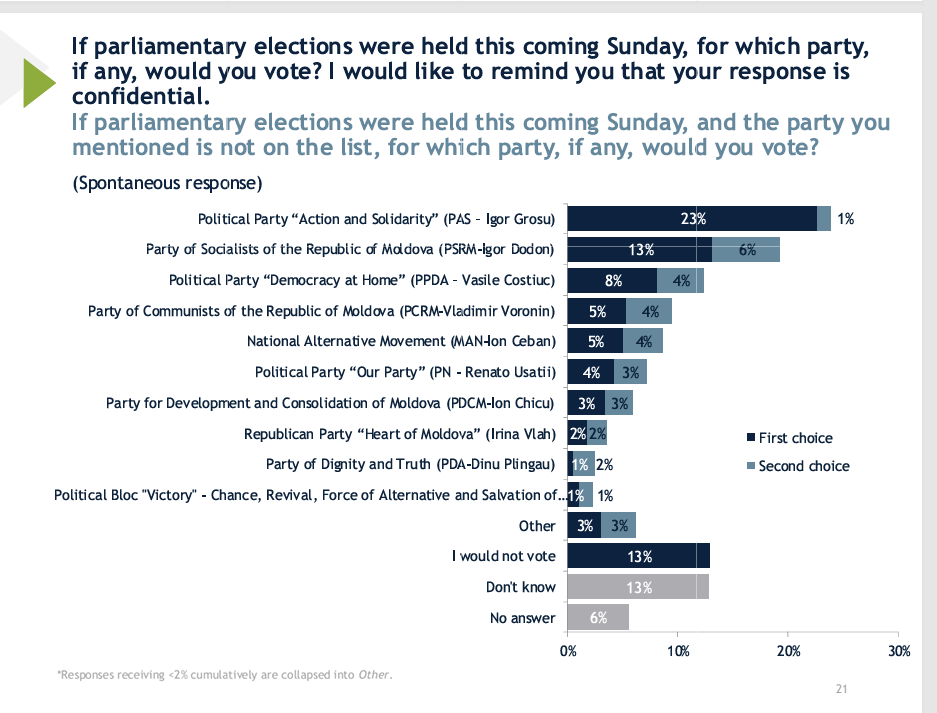
The Party Our Party, led by Renato Usatii, was named as the first choice by 4% of respondents and as the second choice by 3%. The Party for Development and Consolidation of Moldova (PDCM), led by Ion Chicu, received 3% for both first and second preferences.
The Republican Party “Heart of Moldova”, led by Irina Vlah, received 2% for both first and second choices. The Democracy and Truth Party (PDA), led by Dinu Plingau, was named as the first choice by 1% of respondents and as the second choice by 2%.
Meanwhile, 13% of respondents said they would not vote, another 13% were undecided about whom to support, and 6% declined to answer. Other political options accounted for 3% in each of the two preference categories.
The survey was conducted by Magenta Consulting on behalf of the International Republican Institute’s (IRI) Center for Insights in Survey Research.
Data was collected between September 16 and October 13, 2026, through face-to-face interviews conducted at respondents’ homes.
The sample included 1,229 people aged 18 and over who were eligible to vote. It is representative of Moldova’s general population, excluding the Transnistrian region. Sampling was based on gender, region and place of residence (urban or rural), using National Bureau of Statistics data for 2025.
The margin of error for the national sample is 2.8 percentage points, while the response rate was 35%.
The survey was funded with support from the Government of Sweden.