




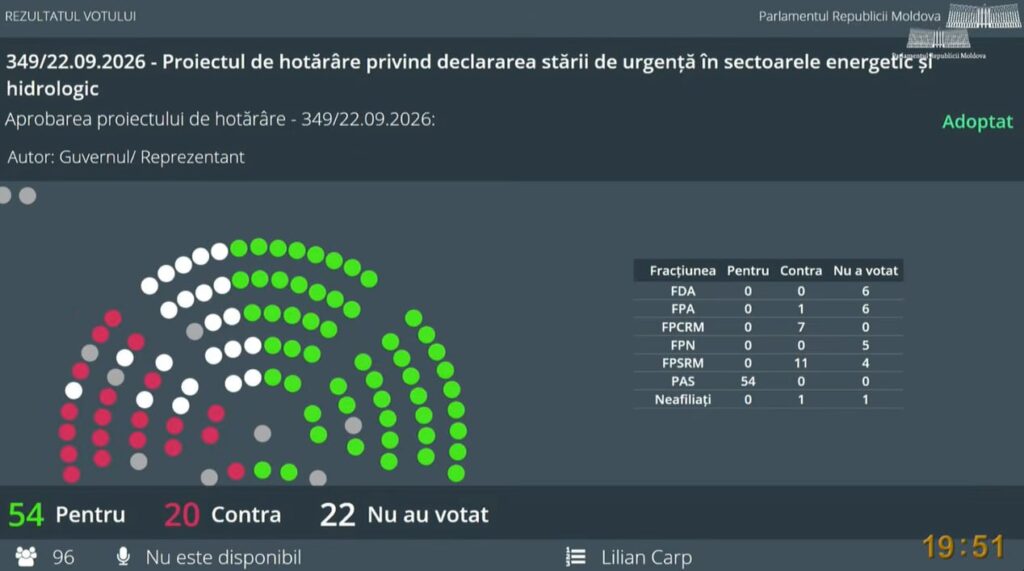
Parliament has approved, by 54 votes, the introduction of a state of emergency in Moldova’s energy and hydrological sectors for a period of 60 days. The measure will take effect on September 26.
The declaration aims to prevent fuel shortages and ensure the continuity of electricity, natural gas and heating supplies. The measures also seek to address the hydrological deficit in the Dniester and Prut river basins, ensure access to drinking water, secure critical water intake facilities and mitigate the economic impact on vulnerable consumers during the autumn-winter period.
President Maia Sandu had previously warned that Moldova faces risks related to both energy supplies and water resources. According to Sandu, the country is heavily dependent on imports, while international markets have seen rising prices and supply disruptions.
The benchmark price of natural gas on the European market has exceeded €83 per MWh, equivalent to approximately $1,000 per 1,000 cubic meters. Meanwhile, diesel prices have surpassed $1,500 per ton amid reduced availability of petroleum products.
Sandu also pointed to disruptions along international routes used to transport liquefied natural gas, including the situation around the Strait of Hormuz and Bab el-Mandeb, as well as attacks on oil infrastructure in the region.
Another concern is the hydrological situation. According to the president, water inflows into the Novodnestrovsk reservoir have fallen to a very low level. Between September 1 and 20, the average inflow was 23 cubic meters per second, compared with the usual 100–120 cubic meters per second for this period.
At the same time, Moldova has increased its renewable energy generation capacity. According to Sandu, renewables’ share of total consumption has risen from 3% to approximately 22%, while storage capacity has reached 210 MWh. However, 600–1,000 MWh of storage capacity would be needed to cover peak demand.
Following a meeting of the Supreme Security Council, authorities established several measures to prepare for the cold season. These include developing plans for different crisis scenarios, securing electricity import capacity and alternative supply routes, and using the 110 kV interconnections with Romania on an emergency basis.
Authorities will also seek to maximize commercial capacity at the Romania–Moldova border and create reserves of equipment and spare parts for emergency repairs. The measures also include securing the necessary gas stocks and gradually building emergency reserves of petroleum products.
Moldova currently has a state of alert in place in the energy and hydrological sectors. The measure was recently extended by another 30 days amid energy risks and drought.
For the 2026–2027 cold season, the Government has previously approved a plan containing 52 measures and scenarios aimed at ensuring the continuity of electricity, gas, heating and petroleum product supplies.