



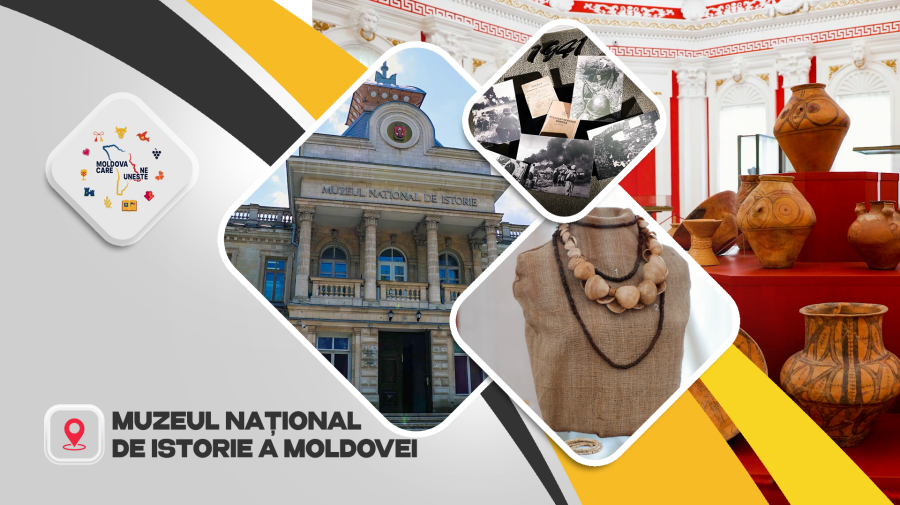
In the heart of Chisinau, inside a historic building that once housed the city’s boys’ gymnasium, stands one of the country’s most important institutions dedicated to preserving and exploring Moldova’s past: the National History Museum of Moldova.
The museum was established on December 21, 1983, and has since become one of the country’s main centers for researching, preserving and promoting its national historical heritage.
The museum’s original collections came from the Museum of Military Glory and the historical collections of the State Museum of History and Study of the Native Land. Over time, they were expanded through archaeological research, donations, acquisitions and heritage transfers from several former republican museums.
A major milestone in the museum’s development came in 1991, when its first permanent history exhibition, “Pages of Multimillennial History,” opened to the public. Initially arranged across three rooms on the upper floor, covering approximately 930 square meters, the exhibition featured around 900 artifacts and traced the history of the region between the Dniester and Prut rivers from ancient times to 1940.
In 1997, the exhibition was redesigned and expanded to cover the entire floor, growing to six rooms and approximately 1,400 square meters of exhibition space. Its historical journey begins with the Paleolithic period and continues through the early 1990s.
In 2014, the museum’s basement became home to another important exhibition, “Treasures of the Past.” It brings together some of the institution’s most significant gold and silver artifacts discovered across the territory of the Republic of Moldova.
Recently opened, the “Memory of War. 1939–1945” exhibition features around 280 museum objects, including photographs, documents, military uniforms, weapons, personal belongings of wartime participants, letters from the front, war trophies, medals and period posters. The exhibition also includes a diorama of the Iasi-Chisinau Operation, recreating dramatic episodes from the history of World War II.
Today, the National History Museum of Moldova holds more than 350,000 heritage objects. Its collections include archaeological artifacts, historical documents, photographs, coins, old books, technical objects, textiles, weapons and armor, as well as works of art.
Among the largest collections is the archaeological collection, comprising more than 47,000 objects discovered through excavations and archaeological research. The museum’s photographic collection contains nearly 49,000 images documenting the region’s social and cultural life from the second half of the 19th century to the present day.
The numismatic collection is another highlight, bringing together more than 61,000 ancient, medieval and modern coins.
Preserving the country’s heritage is another major part of the museum’s work. Its Conservation and Restoration Department has operated since 1994 and includes specialized laboratories for old books, icons, metals, ceramics, textiles and furniture.
Every year, approximately 150 damaged museum objects undergo restoration, helping preserve them for future generations.
The National History Museum of Moldova is located at 121A 31 August 1989 Street in Chisinau. It is open from 10:00 a.m. to 5:00 p.m. during the winter season and until 6:00 p.m. during the summer. The museum is closed on Mondays.
In front of the building stands the famous Capitoline Wolf statue depicting the she-wolf with Romulus and Remus — one of the best-known landmarks of the site, where visitors can discover Moldova’s history step by step.