



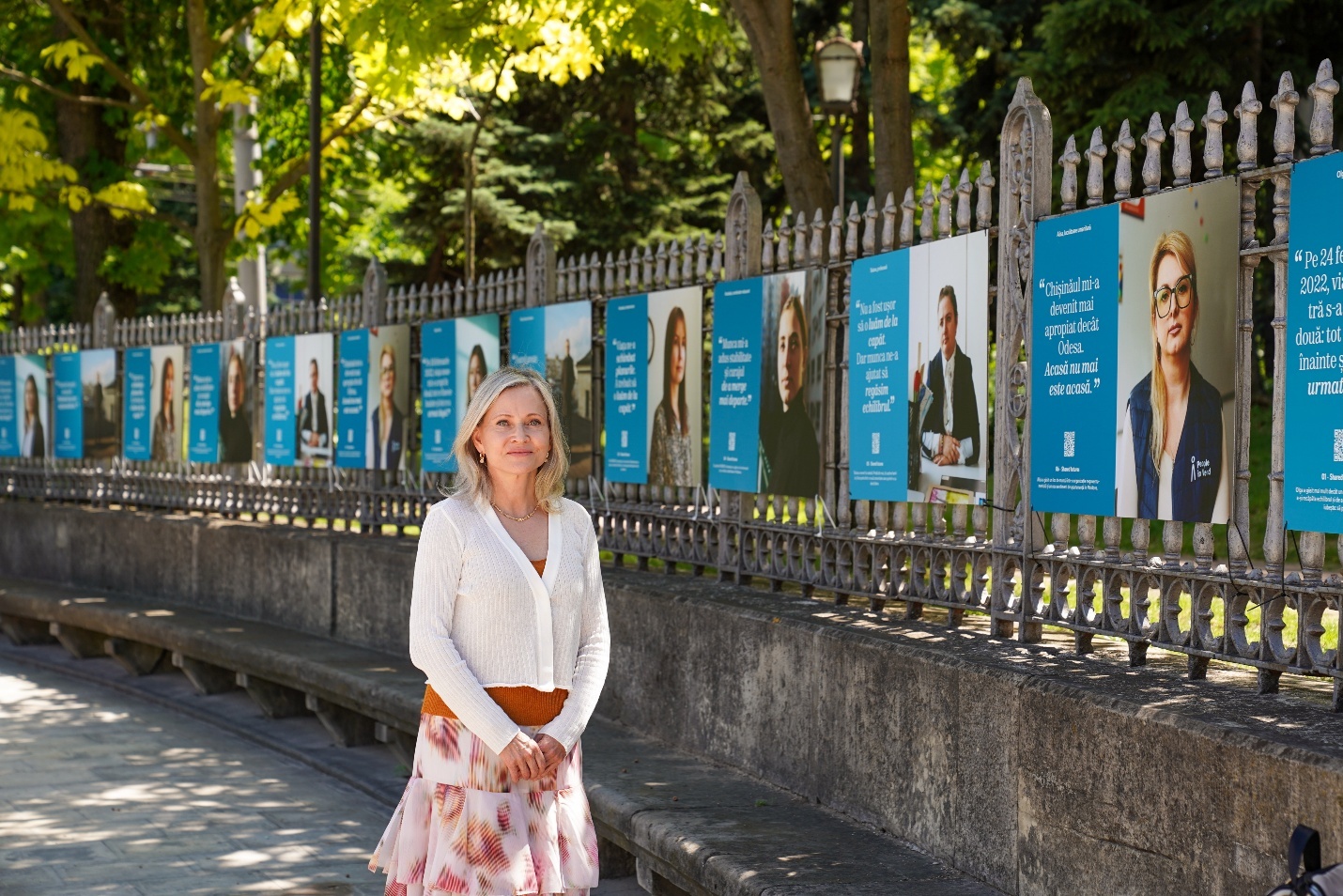
By Katja Saha, UNHCR Representative in the Republic of Moldova.
Too often, discussions about refugees focus only on humanitarian costs. Yet, the reality is often quite different. In Moldova, the real question is not whether the country can afford to integrate refugees into the labour market—it is whether it can afford not to.
A few weeks ago, I met Tatiana, a Ukrainian refugee who lives in the Republic of Moldova, where she was able to return to her profession as a teacher. At first glance, her story did not seem extraordinary. Millions of forcibly displaced people around the world are trying to rebuild their lives after conflict and crisis.
“Starting over was frightening at first,” she said. “You arrive somewhere new and suddenly everything familiar disappears. Work helped us regain a sense of stability.”
Her words stayed with me because they captured something often missing from public debates about displacement: work is not only a source of income. It is a source of dignity, independence, and identity after war, violence, or persecution has stripped much of them away. And if restoring dignity and independence are not reason enough to support refugee inclusion in the labour market, there is another powerful argument: economics.
Moldova offers a compelling example. UNHCR analysis of a study supported by the Joint Data Centre on Forced Displacement shows both the economic potential of refugee employment in the country and the cost of leaving it unrealized.Refugees in formal jobs generate roughly seven times more revenue for the state than those who remain unemployed or in informal work. In the industrial sector alone, enabling just 5,000 additional refugees to enter formal employment could generate around USD 30 million in annual public revenue. The opportunities are even greater in skilled and service-based sectors, where increased labour market participation could translate into significantly larger fiscal returns.
The same study also helps explain why so many refugees are unable to put their skills to use. More than 80 percent of working-age Ukrainian refugees in Moldova have previous professional experience, and roughly three-quarters hold higher education or vocational qualifications. Yet only around one-third have secured paid employment, formal or informal, since arriving.
This is not a reflection of a lack of motivation or talent. Rather, it points to barriers commonly found across refugee-hosting countries, including language challenges, lack of childcare, non-recognition of qualifications, and rules that inadvertently exclude people from employment support services. These barriers are often seen as administrative or technical challenges. In reality, they carry a much higher cost. Every obstacle that prevents a qualified refugee from working also prevents employers from accessing talent and governments from benefiting from additional taxpayers and contributors.
This is particularly relevant at a moment when governments and international donors are searching for more sustainable responses to prolonged displacement. While humanitarian aid remains essential in times of crisis, employment offers something that aid alone cannot: the opportunity for refugees to have greater agency over their own lives. Work brings dignity, income, and independence; employers access much-needed talent; host countries strengthen their economies; and public budgets face fewer long-term pressures. Work is more than a bridge to resilience and hope. It helps people maintain their skills and assets, leaving them better prepared for the day they can safely return to their country of origin.
In humanitarian and development collaboration, we frequently talk about self-reliance as a goal. Employment plays a central role in making it a reality. Evidence helps show where action is needed: where skills are going unused, what prevents people from working, and whether policies are opening real pathways into decent work.
As Barham Salih, UN High Commissioner for Refugees, said:“We must measure success by whether people can rebuild their lives.” For millions of displaced people, access to active employment support and decent work offers precisely that opportunity.
When I think about this debate, I think about Tatiana. Not because her story is exceptional, but because it is not – it reflects the reality of millions. Across Moldova and around the world, there are teachers, nurses, engineers, entrepreneurs, and parents who have lost their homes but not their skills, ambition, or determination. What they are looking for is not dependency. It is opportunity.
Moldova points to a simple challenge: not how to support refugees forever, but how to remove the barriers that prevent them from contributing today. Because when refugees work, families regain stability, businesses find skills, and countries strengthen their economies.
Talent does not stop at the border.
Katja Saha, UNHCR Country Representative in Moldova, at the exhibition Shared Future, curated by UNHCR and the European Bank for Reconstruction and Development.
Credit: UNHCR 2026/Ana-Maria Botnarescu
OP- ED pitch
We are pleased to offer for your consideration an op-ed by Katja Saha, UNHCR Representative in the Republic of Moldova, on why enabling refugees to work is both a matter of dignity and a smart economic choice. Drawing on new evidence from a study supported by the World Bank-UNHCR Joint Data Centre on Forced Displacement and the experience of Ukrainian refugees in Moldova, the op-ed argues that removing barriers to formal employment can help refugees rebuild their lives, give employers access to valuable skills, and strengthen the national economy.
_________
About the Author: Katja Saha is the UNHCR Representative in the Republic of Moldova. She holds a master’s degree in law from the University of Lapland, Finland, and postgraduate qualifications in NGO Management and International Cooperation from Spain. Since joining UNHCR in 2003, she has held senior positions across the Middle East, Africa, Latin America, and Europe, including regional roles at UNHCR Headquarters in Geneva. Prior to her appointment in Moldova, she served as UNHCR Representative in Cyprus.
About the Joint Data Centre on Forced Displacement (JDC):The JDC, a World Bank–UNHCR partnership, catalyses and convenes efforts to strengthen national data systems and embed forcibly displaced populations within official statistics. It works to improve the availability and use of evidence on forced displacement globally and to ensure that relevant data and analysis reach those making policy and operational decisions affecting refugees, internally displaced persons, and host communities.