



Moldova’s European integration process is often discussed in political terms, but its real trajectory is defined by measurable institutional benchmarks, legal alignment requirements, and administrative capacity indicators.
As the country enters the 2026–2030 period, the EU accession process is no longer aspirational. It is now a structured negotiation framework governed by extensive regulatory harmonisation requirements.
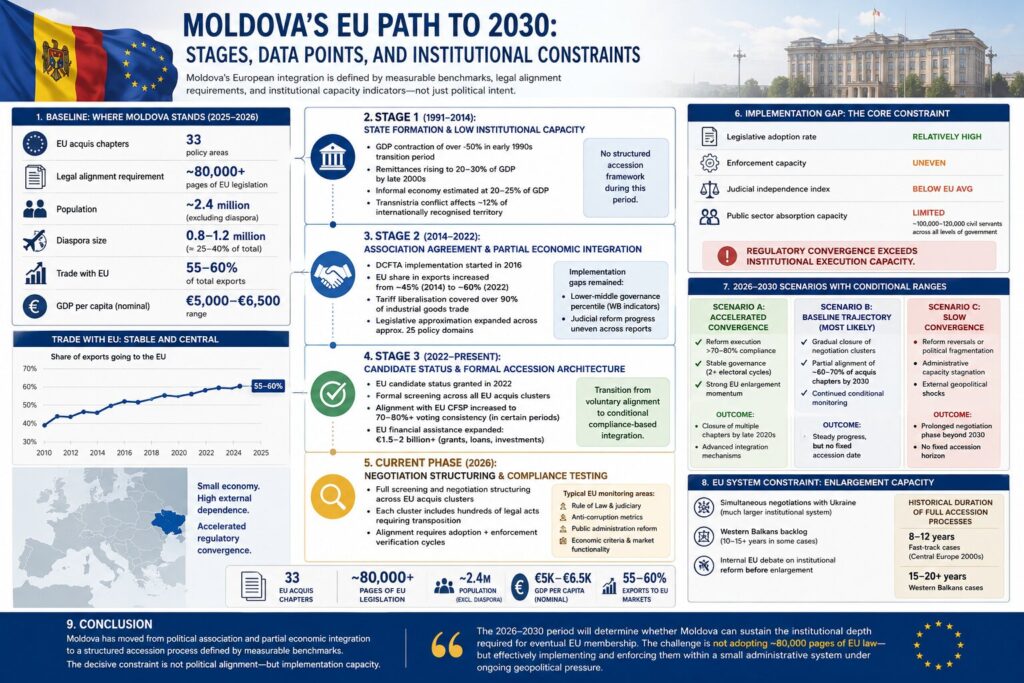
1. Baseline: Where Moldova Stands in Numbers (2025–2026)
To understand the current phase, it is important to outline the structural baseline:
- EU acquis chapters: 33 policy areas (clusters under revised enlargement methodology)
- Legal alignment requirement: ~80,000+ pages of EU legislation (acquis communautaire)
- Population: ~2.4 million (excluding diaspora)
- Diaspora size: estimated 0.8–1.2 million abroad (approx. 25–40% of total population base)
- Trade with EU: over 55–60% of total exports go to EU markets (stable post-DCFTA trend)
- GDP per capita (nominal): ~€5,000–€6,500 range (fluctuating depending on methodology)
These indicators define Moldova as a small, highly externally dependent economy undergoing accelerated regulatory convergence with the EU.
2. Stage 1 (1991–2014): State Formation and Low Institutional Capacity
This period is characterised by weak institutional consolidation and fragmented policy capacity.
Key structural indicators:
- GDP contraction of over -50% in early 1990s transition period
- remittances rising to 20–30% of GDP by late 2000s
- persistent informal economy estimated at 20–25% of GDP
- Transnistria conflict affecting ~12% of internationally recognised territory
During this phase, EU integration was not operationally measurable, as Moldova lacked a structured accession framework.
3. Stage 2 (2014–2022): Association Agreement and Partial Economic Integration
The EU–Moldova Association Agreement (including DCFTA) created the first measurable integration framework.
Key data points:
- DCFTA implementation started in 2016
- EU share in exports increased from ~45% (2014) to ~60% (2022)
- tariff liberalisation covered over 90% of industrial goods trade
- legislative approximation expanded across approx. 25 policy domains
However, implementation gaps remained significant:
- World Bank governance indicators placed Moldova in the lower-middle governance percentile globally
- judicial reform progress remained uneven across multiple EU monitoring reports
This phase is best described as economic integration without institutional convergence.
4. Stage 3 (2022–present): Candidate Status and Formal Accession Architecture
EU candidate status (granted in 2022) introduced Moldova into a structured accession mechanism.
Key institutional implications:
- activation of formal screening process across all EU acquis clusters
- alignment with EU Common Foreign and Security Policy increased to over 70–80% voting consistency in certain periods
- expansion of EU financial assistance through multi-annual support packages exceeding €1.5–2 billion (combined grants, loans, and investment frameworks)
This stage marks the transition from voluntary alignment to conditional compliance-based integration.
5. Current Phase (2026): Negotiation Structuring and Compliance Testing
Moldova is now entering the operational negotiation phase, where progress is evaluated through granular benchmarks.
Typical EU accession monitoring structure includes:
- Rule of Law benchmarks: judicial independence, prosecutorial autonomy
- Anti-corruption metrics: institutional enforcement rates, conviction consistency
- Public administration reform indicators: civil service depoliticisation
- Economic criteria: market functionality and regulatory alignment
At this stage:
- each negotiation cluster can include hundreds of legal acts requiring transposition
- full alignment requires not only adoption but enforcement verification cycles
6. Implementation Gap: The Core Structural Constraint
Across EU enlargement cases, the decisive variable is not legislative adoption, but implementation efficiency.
In Moldova’s case, the gap is structurally significant:
- legislative adoption rate: relatively high under EU harmonisation pressure
- enforcement capacity: uneven across institutions
- judicial independence index: persistently below EU average benchmarks
- public sector absorption capacity: limited by administrative size (~100,000–120,000 civil servants across all levels of government)
This creates a structural bottleneck: regulatory convergence exceeds institutional execution capacity.
7. 2026–2030 Scenarios with Conditional Ranges
Rather than a fixed timeline, EU accession should be understood through scenario-based ranges:
Scenario A: Accelerated convergence
Conditions:
- sustained reform execution >70–80% compliance rate across clusters
- stable governance across at least 2 electoral cycles
- strong EU enlargement momentum
Outcome:
- closure of multiple negotiation chapters by late 2020s
- potential advanced integration mechanisms (without guaranteed membership)
Scenario B: Baseline trajectory
- gradual closure of negotiation clusters
- partial alignment of ~60–70% of acquis chapters by 2030
- continued conditional monitoring framework
This reflects the typical pace of EU enlargement in structurally small transition economies.
Scenario C: Slow convergence
Triggered by:
- reform reversals or political fragmentation
- administrative capacity stagnation
- external geopolitical shocks
Outcome:
- prolonged negotiation phase beyond 2030
- no fixed accession horizon
8. EU System Constraint: Enlargement Capacity
Moldova’s trajectory is also constrained by EU-level structural factors:
- simultaneous negotiations with Ukraine (much larger institutional system)
- Western Balkans backlog (some processes ongoing for 10–15+ years)
- internal EU debate on institutional reform before enlargement
Historically, full EU accession processes have taken:
- 8–12 years (fast-track cases like Central Europe in 2000s)
- 15–20+ years (Western Balkans cases)
Moldova currently sits closer to the second category in institutional terms, despite accelerated political momentum.
9. Conclusion
Moldova’s EU integration path is now a fully structured accession process defined by measurable institutional benchmarks rather than political intent.
By 2026, the country has already completed:
- initial political association phase
- partial economic integration via DCFTA
- formal transition into accession negotiations
However, the decisive constraint remains implementation capacity rather than political alignment.
The 2026–2030 period will therefore not determine accession itself, but will determine whether Moldova can sustain the institutional depth required for eventual membership.
In quantitative terms, the challenge is not adopting EU law — but effectively implementing and enforcing approximately 80,000 pages of regulatory standards within a small administrative system under ongoing geopolitical pressure.