



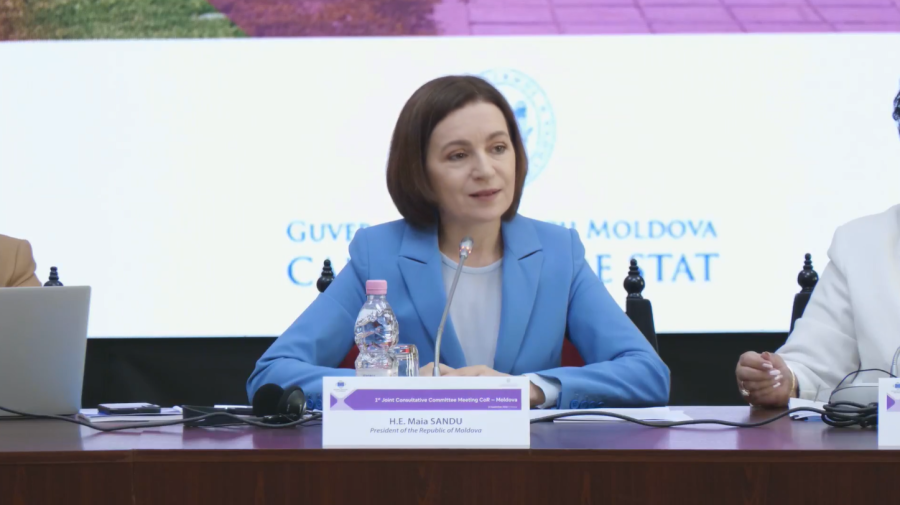
“We are not carrying out reforms for the sake of reforms; we are doing them to achieve results that will give people confidence,” President Maia Sandu told mayors of localities involved in Moldova’s voluntary amalgamation process. She said communities need stronger administrations, sufficient budgets and public services that meet people’s needs.
“I know that voluntary amalgamation involved lengthy negotiations, continuous dialogue with residents and finding solutions acceptable to the communities involved. You took responsibility for leading a complex but necessary process because we need prosperous villages and towns, well-planned infrastructure and public services adapted to people’s real needs,” the president said at the inaugural meeting of the Joint Consultative Committee between the European Committee of the Regions and the Republic of Moldova on September 15.
According to Sandu, authorities must carefully set priorities and direct resources toward the problems that affect communities most, including inadequate water and sewage systems, roads and other essential services.
“We need to carefully establish our priorities and use resources where they are most needed — for water and sewage systems, better roads and essential services that too many localities still lack,” Sandu said.
The president explained that the reform is also necessary because of population decline in local communities, which has led to lower revenues for local administrations.
“Moldova and our localities have lost a large part of their population because living standards did not meet people’s expectations and were not at the same level as the standards they found elsewhere. This population decline has led to lower local revenues, creating a problem that must be stopped. We need to reverse this trend,” Maia Sandu said.
The head of state said amalgamated communities would have better chances of attracting and implementing large-scale projects.
“We need appropriate public administration structures equipped with adequate budgets. This is the objective of the administrative-territorial reform, and the government is focused on local development. Amalgamated communities have better chances of implementing large-scale projects for the benefit of citizens,” she said.
At the same time, Sandu stressed that decentralization cannot work without sufficient financial resources for local authorities.
“We need to build and provide local authorities with both the necessary powers and resources. Decentralization only makes sense when it is accompanied by the resources needed. Localities must be able to benefit from the opportunities offered by the Growth Plan for Moldova. Only if we make efforts in this direction will we be able to improve people’s living standards,” the president added.
Sandu also said local administrations must be prepared for new challenges, including those related to security and climate change.
“The world around us is changing, and we must adapt our administrations to these new realities so that people can live in a better and safer world. Only strong local authorities, with effective teams, consolidated budgets and the right tools, can protect communities from security threats, climate change and other risks,” Sandu said.
The inaugural meeting of the Joint Consultative Committee between the European Committee of the Regions and the Republic of Moldova is taking place on Tuesday, September 15, at the Palace of the Republic in Chisinau.
Among those attending are Government Secretary General Alexei Buzu, EU Ambassador to Moldova Iwona Piórko and Patrick Molinoz, the committee’s co-chair representing the European Committee of the Regions.
The voluntary amalgamation stage ended on September 1, following an extension of the deadline. According to data presented during the process, 561 mayors’ offices approved final decisions on voluntary amalgamation. The government has allocated 4.5 billion lei in financial incentives and infrastructure investments for communities that chose to merge.