



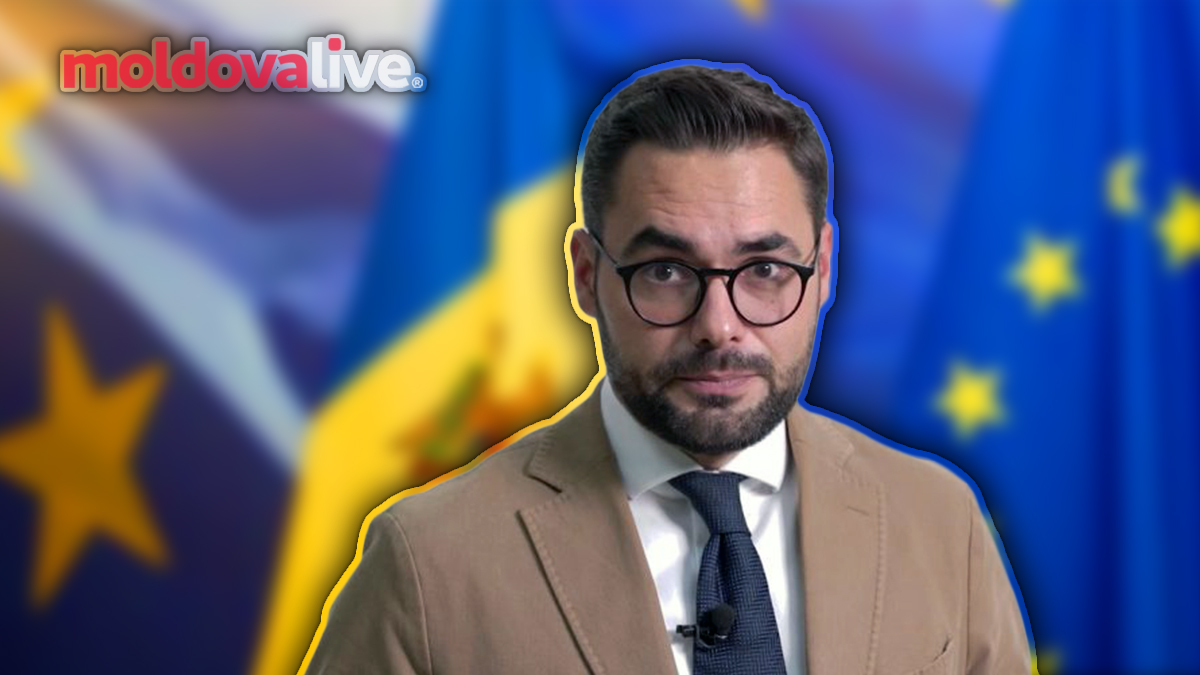
Moldova is entering a critical autumn for its European integration, with two possible scenarios emerging as Hungary continues to block progress on Ukraine’s EU accession talks. Iulian Groza, Executive Director of the Institute for European Policies and Reforms (IPRE), says Chisinau could either move forward together with Kyiv if the political deadlock is resolved, or see its accession process gradually decoupled from Ukraine at the technical level.
“I believe both scenarios have an equal probability,” Groza told RFI.
According to Groza, Moldova is still being treated politically as part of the same package as Ukraine at the EU level, even though technical negotiations with Chisinau are continuing.
The European Commission has sought to prevent the political deadlock from slowing Moldova’s technical progress. A “front-loading” mechanism has allowed the Commission to continue technical work on the accession process while EU member states have yet to reach the necessary political decisions.
For Moldova, Groza says, this autumn could prove decisive.
A critical autumn for Moldova’s EU path
European Commissioner for Enlargement Marta Kos has described the current period as the “autumn of enlargement,” while the European Commission is expected to set out its vision for the next stage of EU enlargement.
Groza expects the Commission to clarify its approach by the end of September, including how it sees the accession prospects of the candidate countries over the coming years.
Montenegro, which is the most advanced candidate country in the negotiations, is already preparing its accession treaty, while Albania has also made significant progress.
For Moldova, the immediate objective is particularly ambitious: to open all negotiating clusters this year and begin closing some of them.
A key milestone will be the European Commission’s assessment of Moldova’s interim benchmarks under Chapters 23 and 24, covering the judiciary, fundamental rights and the fight against corruption.
“The most important moment will be when the Commission provides its assessment of the interim benchmarks under Chapters 23 and 24,” Groza said.
If Moldova can demonstrate a credible track record and sustained progress in these areas, Groza believes it could pave the way for opening and beginning to close negotiations in other areas.
Justice reform is the decisive test
Justice reform remains one of the most closely watched elements of Moldova’s accession process.
Groza argues that Moldova’s justice system has undergone a profound transformation over the past several years, although significant work remains.
He pointed to the creation of a new Supreme Court of Justice, a reformed Superior Council of Magistracy and a new Superior Council of Prosecutors as evidence of institutional change.
At the same time, he stressed that the government and parliament cannot deliver judicial reform on their own.
“The institutions of justice also have to deliver,” Groza said.
According to him, the responsibility for meeting the EU’s benchmarks is shared between the political authorities and the institutions of the justice system themselves.
The government and parliament are responsible for legislation, reforms and budgetary decisions, while prosecutors, judges and judicial institutions must demonstrate concrete results.
Groza says there are already signs that the system is beginning to function differently.
He pointed to major corruption and fraud investigations that are moving forward, as well as court decisions in cases that had been delayed for years.
“These are signs that the justice system has begun to reorganize itself and has begun to function,” he said.
The challenge now, he added, is to maintain both the speed and quality of judicial decisions.
Moldova must not wait for political decisions
While the final decision on enlargement remains political, Groza says Moldova should focus on the elements of the process it can control.
The country has set 2030 as its target for EU accession readiness, a goal he acknowledges is highly ambitious but one that should not be abandoned.
“2030 is a very ambitious deadline, but it is a deadline we must stick to and work toward so that we are ready,” Groza said.
He warned that Moldova has a limited window in which to make substantial progress.
The country currently has no elections ahead of it in the immediate period, while local elections are scheduled for next year, followed by presidential and parliamentary elections in subsequent years.
At the European level, new electoral cycles are also approaching.
Groza argues that Moldova should therefore use the current period to advance as much as possible, rather than wait for political decisions in Brussels.
“If we miss this calendar, it will be much harder for us to move forward with negotiations starting next year,” he said, pointing to upcoming electoral cycles across Europe.
He also warned that the rise of illiberal, sovereigntist and far-right and far-left political forces could make securing a strong consensus for further EU enlargement more difficult.
For this reason, Moldova must ensure that there are no doubts about its technical preparedness.
Hungary remains a major obstacle
One of the key political obstacles is Hungary’s continued opposition to advancing Ukraine’s EU accession process.
Groza says there had been hopes that a change in government in Budapest would help resolve the deadlock, but the process has proven more complicated.
Hungary continues to raise concerns regarding the rights of national minorities and ethnic Hungarians in Ukraine.
According to Groza, Ukraine and Hungary remain in direct contact and are trying to resolve their differences, while Chisinau is also engaging with Budapest.
Moldovan authorities, he said, are working with EU member states to build the consensus necessary to keep enlargement moving.
Moldova itself, Groza stressed, should not have to wait for Ukraine — just as Ukraine should not have to wait for Moldova.
However, the political reality is that the two countries remain closely linked in the current EU decision-making process.
The question is therefore whether EU member states will eventually overcome the political deadlock or whether Moldova’s process will be separated from Ukraine’s at the technical level.
“I believe both have the same probability, because both are political decisions at the European level,” Groza said.
Unification with Romania is not a “Plan B”
Groza also rejected the idea, raised in a recent Economist analysis, that unification with Romania could serve as a backup plan if Moldova’s EU accession process were to stall.
“I do not see unification or reunification with Romania as a Plan B,” he said.
Instead, he described closer integration between Moldova and Romania as a converging process that could develop if sufficient political will and public support exist in both countries.
Groza noted that support for reunification in Moldova has increased significantly in recent years, according to polling he has reviewed, from around 15–20% several years ago to roughly 35–40%.
He also pointed to the growing number of Moldovan citizens who hold or are seeking Romanian and other EU citizenships.
However, he stressed that reunification should not be used as a political instrument or as an alternative to European integration.
“Moldova’s accession to the European Union is the plan — the only realistic plan Moldova has,” Groza said.
He argued that Moldova and Romania are already building stronger economic, institutional, social and cultural links, creating what he described as bridges and interconnections between the two countries.
Russia and the growing hybrid threat
Another factor that could influence Moldova’s European trajectory is Russia’s expanding hybrid warfare campaign.
Groza described Russia as “the biggest threat to Europe today” and warned that Moscow is seeking to create division, chaos and confrontation both within European countries and between them.
According to him, Russia is also attempting to fuel extremist narratives in order to weaken European states and the European Union as a whole.
Moldova’s response, he said, should be to strengthen national resilience and social cohesion.
“This responsibility belongs to everyone,” Groza said, referring to the government, opposition parties, public institutions, civil society and citizens.
He argued that Moldova needs to strengthen its ability to respond to unconventional and hybrid threats while continuing to adapt to changes in Russia’s tactics.
At the European level, Groza is also looking toward the European Commission’s upcoming State of the Union address and the expected development of a stronger European security strategy.
Moldova’s next steps
For Chisinau, the immediate priority is to continue advancing regardless of the political uncertainty surrounding Ukraine.
Moldova needs to maintain the pace of reforms, demonstrate progress in justice and anti-corruption, implement the commitments included in its accession programme and make the strongest possible case to EU member states.
The political decision on enlargement ultimately lies with the EU member states. But Groza argues that Moldova can strengthen its position by ensuring that its own reforms are progressing and that the country is technically ready.
The coming months could therefore determine how much momentum Moldova can carry into the next stage of its accession process.
For now, two paths remain possible: overcoming the political deadlock surrounding Ukraine and allowing both countries to advance, or finding a way for Moldova to continue progressing separately at the technical level.
Either way, Groza believes Moldova cannot afford to wait.
The objective remains unchanged: to keep the accession process moving and make the country ready for EU membership by 2030.