



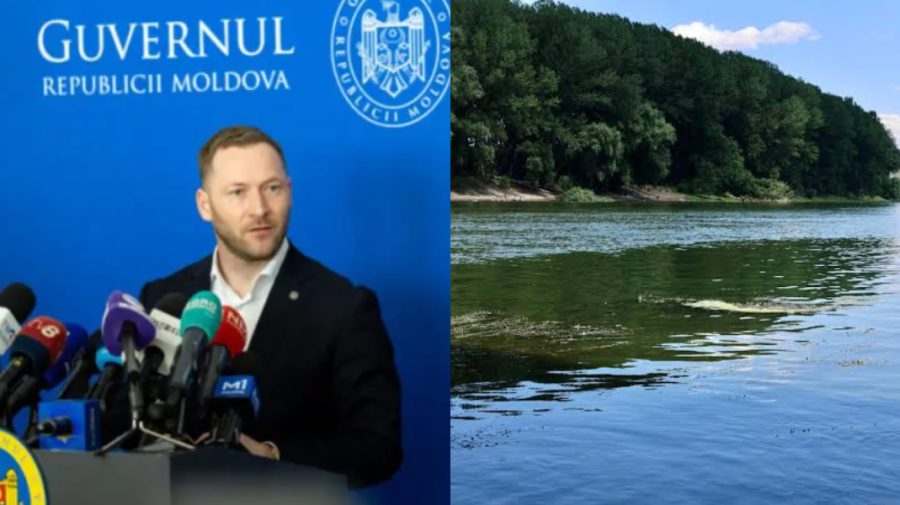
The Republic of Moldova continues to face a difficult situation on the Dniester River amid a state of emergency in the hydrological sector and a sharp decline in the river’s flow.
Environment Minister Gheorghe Hajder says that, theoretically, a flow of 30 cubic meters per second would be sufficient to supply Moldova’s cities with water, but the country’s infrastructure needs to be adapted to operate under such conditions.
“Thirty cubic meters per second is, at least theoretically, a volume of water that is sufficient to supply the cities of the Republic of Moldova,” Hajder said, referring to the situation on the Dniester and the risk of possible water supply disruptions.
According to the minister, the current situation has been caused by an unprecedented decline in water levels, amid a drought that has persisted for several months upstream of the Novodnestrovsk reservoir.
Hajder said Moldova needs to upgrade its water intake and supply infrastructure so that it can continue operating even when river flows are lower.
“We need to readjust our infrastructure so that we can collect water even at lower flows, such as 30 cubic meters per second, and be prepared for any scenario,” the minister stressed.
Authorities are monitoring the Dniester’s flow as the state of emergency in the hydrological sector remains in effect due to the water deficit and risks to the country’s water supply.
The Environment Minister also highlighted the increasingly visible effects of climate change, saying they are no longer a distant phenomenon.
“Unfortunately, climate change is no longer a distant phenomenon. We are already feeling it, and the entire region is already feeling something,” Gheorghe Hajder said.
The critical water level in the Dniester and possible solutions to maintain water supplies were discussed by authorities on Tuesday, September 29.
Prime Minister Vasile Tofan convened a working meeting with representatives of the Ministry of Environment, the National Administration “Apele Moldovei,” Chisinau City Hall and Apă-Canal Chisinau.
Several scenarios for the coming period were discussed during the meeting, as authorities assess measures to maintain water supplies amid the continuing decline in the Dniester’s flow.