



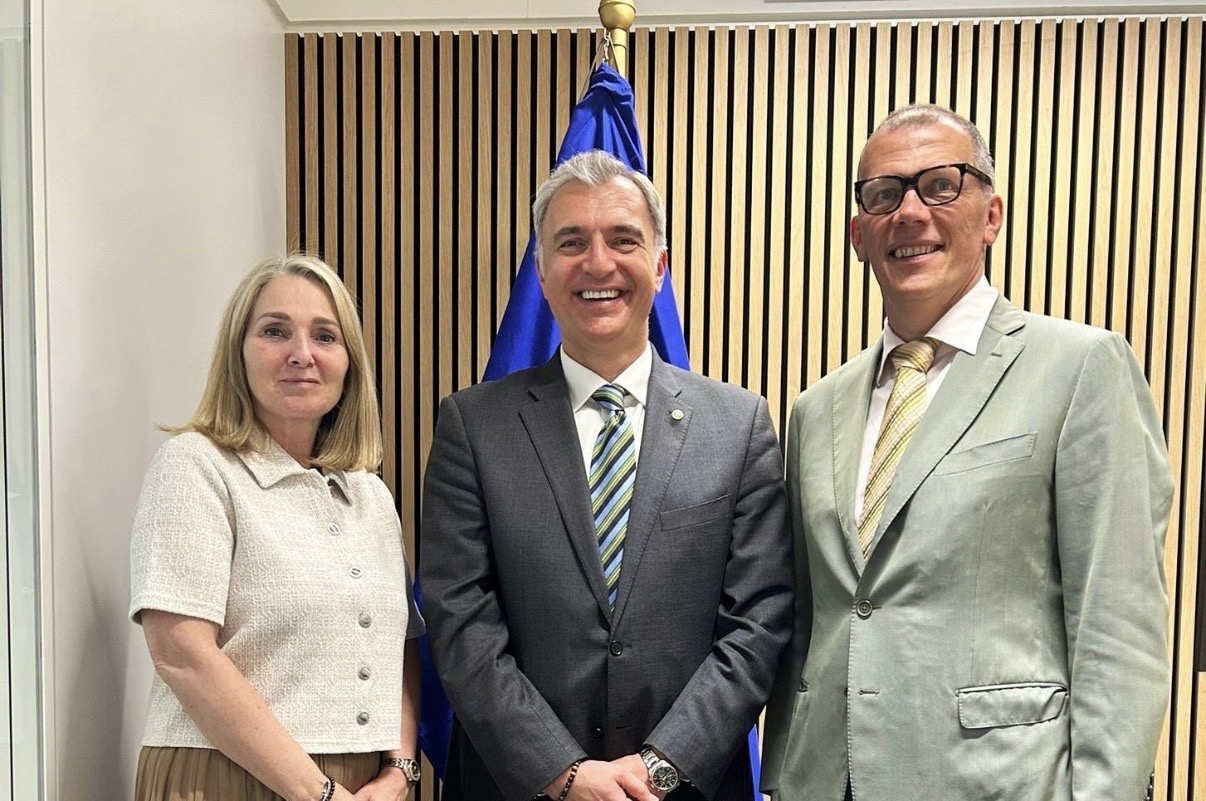
Deputy Prime Minister and Minister of Economic Development and Digitalization Eugeniu Osmochescu, together with State Secretary Cristina Ceban, carried out a working visit to Brussels, where they held a series of meetings with European Commission officials to discuss Moldova’s economic priorities, the implementation of reforms, and the advancement of the European integration process.
The visit agenda included discussions on trade relations between the Republic of Moldova and the European Union, the implementation of the Moldova Growth Plan, the transposition of the EU acquis, energy security, economic resilience, and preparations for the EU–Moldova Investment Conference, which will take place in Chișinău on June 4, 2026.
During the meeting with the Director-General for Enlargement and Eastern Neighbourhood (DG ENEST), Gert Jan Koopman, and Director Mathieu Bousquet, the priorities of the Investment Conference were set, with a focus on attracting investment and strengthening energy security. Progress made by the Republic of Moldova in aligning with the EU acquis and prospects for the provisional closure of negotiations in several chapters where the country has achieved significant results were also reviewed, including in the areas of information society, entrepreneurship policy, and foreign policy.
European officials praised the progress made in reducing bureaucracy for the business environment, digitalizing public services, harmonizing investment legislation, reforming public property, and improving the efficiency of state-owned enterprises. They also welcomed the recognition of Moldova’s progress in the European Commission’s Enlargement Report and the launch of technical negotiations across all six accession clusters.
In the meeting with Deputy Director-General of DG TRADE Léon Delvaux, discussions focused on the implementation of the Deep and Comprehensive Free Trade Area (DCFTA), integration into the European Single Market, and developments regarding the regulation of trade in steel products. Eugeniu Osmochescu reiterated the need to maintain predictable trade conditions for the national steel industry and requested consideration of tariff quota arrangements adapted to Moldova’s production and export capacities.
Discussions with the Director-General of DG ECFIN Maarten Verwey focused on macroeconomic developments, the implementation of the Moldova Growth Plan, and the National Economic Reform Programme 2026–2028. The parties emphasized the need to accelerate structural reforms, strengthen economic competitiveness, and reduce vulnerabilities linked to energy dependence.
An important topic of the visit was industrial cooperation and the development of economic capacities relevant to security and defence. During the meeting with DG DEFIS Director-General Timo Pesonen, opportunities were discussed for integrating Moldovan companies into European value chains, cooperation in dual-use goods, and participation in joint industrial projects with European partners. The European side praised Moldova’s progress in aligning its regulatory framework on export controls and highlighted prospects for gradual integration into European industrial ecosystems.
In dialogue with DG GROW Director for Value Chains and Business Analysis Outi Slotboom, Moldova’s priorities were presented regarding entrepreneurship support, investment attraction, industrialization, and digital transformation. Opportunities offered by European programs and financial instruments, including the Single Market Programme and future competitiveness support mechanisms, were also discussed.
Special emphasis was placed on preparations for concluding the Agreement on Conformity Assessment and Acceptance of Industrial Products (ACAA), considered a strategic objective for facilitating access of Moldovan products to the EU market.
During the meeting with Director-General for Competition at DG COMP Anthony Whelan, reforms in the field of competition and state aid were reviewed. European officials noted progress in harmonizing legislation and strengthening institutional capacities. At the same time, Deputy Prime Minister Osmochescu presented the tax regime applied within the Moldova IT Park, highlighting its role in developing the IT sector, attracting investment, and expanding the tax base.
The visit to Brussels reconfirmed the European Union’s continued support for Moldova’s reform and development agenda, as well as the shared commitment to deepening economic integration and accelerating the country’s EU accession process.